Artificial Bee Colony
Artificial Bee Colony (ABC)
- Year introduced
- 2007
- Original authors
- Dervis Karaboga; Bahriye Basturk
- Source of inspiration
- The nectar foraging behaviour of honey bees
- Search space
- Continuous
- Optimization types
- Hyperparameter Optimization, Feature Selection, Weight Optimization
- Applied research in the repository
- 1
Overview
Each food source is a candidate solution. The employed bee runs a neighbourhood search by changing one dimension, the onlooker chooses sources probabilistically by their quality, and the scout replaces a source that has not improved after limit trials.
Source of inspiration and mechanism
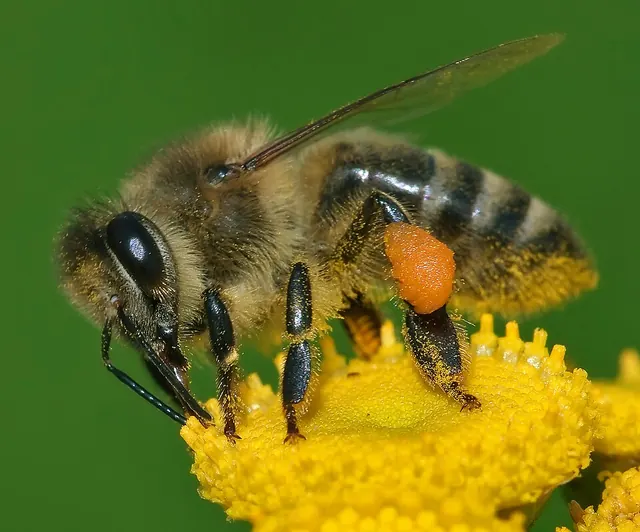
The colony shares three roles: employed bees that exploit known food sources, onlooker bees that choose sources from the dances of the employed bees, and scout bees that search randomly for new sources when a source is exhausted.
Initialization
Uniform random food sources.
Update mechanism
One dimension is changed at a time with greedy selection; the trial counter.
Exploration
The scout phase and the reinitialization of exhausted sources.
Exploitation
The employed and onlooker phases around the good sources.
Mathematical description
The proposed neighbour changes one dimension towards or away from another random source, and is accepted by greedy selection.
Neighbour solution
v_{ij} = x_{ij} + \phi_{ij}\,(x_{ij} - x_{kj}),\quad \phi_{ij}\sim U(-1,1)k≠i random, j a random dimension.
Onlooker selection probability
p_i = \frac{fit_i}{\sum_{n=1}^{SN} fit_n},\quad fit_i = \begin{cases}\frac{1}{1+f_i} & f_i\ge 0\\ 1+|f_i| & f_i<0\end{cases}Scout
x_{ij} = lb_j + U(0,1)\,(ub_j - lb_j)\quad \text{if } trial_i > limitComputational complexity: O(T\cdot SN\cdot (D + C_f))
Pseudocode
Initialize SN food sources; trial = 0
for t = 1..T:
Employed phase: for each source i, create v_i; greedy select
compute p_i ; Onlooker phase: choose sources by p_i, create v, greedy select
Scout phase: if trial_i > limit: reinitialize source i
remember best
return bestPython implementation
This code was actually run while building the lab (NumPy) on the sphere function to make sure it works; this is a run test, not a performance claim.
import numpy as np
def abc(f, lb, ub, dim, food=20, iters=200, limit=None, seed=0):
"""Artificial Bee Colony (Karaboga & Basturk, 2007): employed, onlooker and scout phases."""
rng = np.random.default_rng(seed)
limit = limit or food * dim
X = rng.uniform(lb, ub, (food, dim))
F = np.apply_along_axis(f, 1, X)
trial = np.zeros(food, int)
fitness = lambda v: 1 / (1 + v) if v >= 0 else 1 + abs(v)
best = X[F.argmin()].copy(); bval = F.min(); curve = []
def try_neighbour(i):
nonlocal best, bval
k = rng.choice([j for j in range(food) if j != i])
d = rng.integers(dim)
v = X[i].copy()
v[d] = np.clip(X[i, d] + rng.uniform(-1, 1) * (X[i, d] - X[k, d]), lb, ub)
fv = f(v)
if fv < F[i]: # greedy selection
X[i], F[i], trial[i] = v, fv, 0
else:
trial[i] += 1
for _ in range(iters):
for i in range(food): # employed bees
try_neighbour(i)
fit = np.array([fitness(v) for v in F]); prob = fit / fit.sum()
for _ in range(food): # onlooker bees
try_neighbour(rng.choice(food, p=prob))
worst = trial.argmax() # scout bee
if trial[worst] > limit:
X[worst] = rng.uniform(lb, ub, dim); F[worst] = f(X[worst]); trial[worst] = 0
if F.min() < bval:
bval = F.min(); best = X[F.argmin()].copy()
curve.append(bval)
return best, bval, curve
if __name__ == "__main__":
sphere = lambda z: float(np.sum(z ** 2))
best, val, curve = abc(sphere, -100, 100, dim=10)
print("best fitness:", val)
Coefficients
| Parameter | Symbol | Typical value | Range | Description |
|---|---|---|---|---|
| Food sources | SN | 20 | 10 – 50 | Half of the colony |
| Abandonment limit | limit | SN·D | 50 – 500 | Number of trials before abandonment |
Advantages
- limit
- Good exploration
- Stable on multimodal functions.
Limitations
- Slow exploitation because each update changes one dimension
- Slower convergence in high dimensions.
Use in artificial intelligence
Domains documented in the card: Machine learning, deep learning, Feature Selection, hyperparameter tuning
Continuous optimization, training small networks, clustering, feature selection with the binary versions.
Hybridization potential
- DE — Differential Evolution Design this hybrid
- GA — Genetic Algorithm Design this hybrid
- PSO — Particle Swarm Optimization Design this hybrid
These are partnerships suggested theoretically in the card; any resulting design is presented as a "proposed hybrid method" until its results are compared with the literature.
Applied research from the repository
- A hybrid algorithm using ant and bee colony optimization for feature selection and classification (AC-ABC Hybrid) Partially verified
Related lessons
Original reference
Dervis Karaboga; Bahriye Basturk (2007). A powerful and efficient algorithm for numerical function optimization: artificial bee colony (ABC) algorithm. Journal of Global Optimization, Springer Science and Business Media LLC.
Verified DOI: 10.1007/s10898-007-9149-x
