Bitterling Fish Optimization
Bitterling Fish Optimization (BFO)
- Year introduced
- 2024
- Original authors
- Lida Zareian; Javad Rahebi; Mohammad Javad Shayegan
- Source of inspiration
- European bitterling
- Search space
- Continuous
- Optimization types
- Hyperparameter Optimization, Feature Selection, Weight Optimization
- Applied research in the repository
- 0
Overview
An algorithm inspired by the mating behaviour of the bitterling fish, which lays its eggs inside mussels to protect them, and whose female looks for a male stronger than the others. Its authors applied it with an MLP network and in a binary version to network intrusion detection, feature selection and improving K-means clustering.
Source of inspiration and mechanism
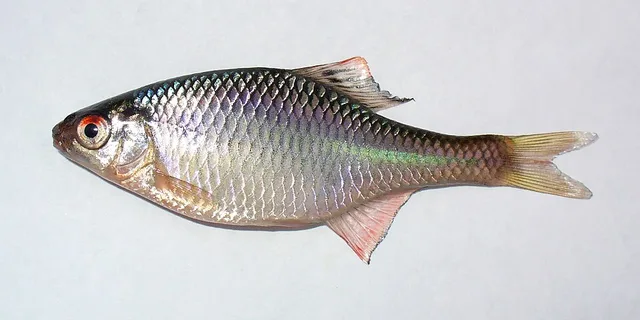
The male bitterling defends a mussel on the bottom, the female lays her eggs inside the mussel through a long tube, then the male fertilizes them, and the mussel protects the embryos. The female prefers the stronger male with the better mussel. Scientific name: Rhodeus amarus.
Initialization
Uniform random distribution inside the bounds of the search space.
Update mechanism
Choosing a partner, then generating new solutions.
Exploration
The females searching for a suitable male.
Exploitation
Generating solutions near the better mussel.
Mathematical description
The better solutions are treated as males with good mussels, and the other solutions (the females) move towards them, with new solutions (young) generated near the chosen mussel. A binary version uses a transfer function for feature selection.
This algorithm's equations were not included because they have not yet been matched with the original text. See the original reference below.
Computational complexity: O(T\cdot N\cdot (D + C_f))
Pseudocode
Initialize
for t = 1..T:
rank fish; males = best, females = rest
females move toward a stronger male (mate selection)
spawn new solutions near the chosen mussel
keep the best N
return bestPython implementation
There is currently no tested python implementation of this algorithm in the lab. We did not include untested code so that it is not used as a reference implementation.
Coefficients
No parameters recorded.
Advantages
Applied directly to machine learning problems (MLP, feature selection, K-means).
Limitations
The comparative results were published by the authors and have not been reproduced experimentally in this encyclopedia.
Use in artificial intelligence
Domains documented in the card: Machine learning, deep learning, Feature Selection, hyperparameter tuning
Feature selection, training neural networks, and clustering.
Hybridization potential
These are partnerships suggested theoretically in the card; any resulting design is presented as a "proposed hybrid method" until its results are compared with the literature.
Applied research from the repository
An aspect that did not appear in the current search results within the repository. This does not mean there is no published research outside it.
Original reference
Lida Zareian; Javad Rahebi; Mohammad Javad Shayegan (2024). Bitterling fish optimization (BFO) algorithm. Multimedia Tools and Applications, Springer Science and Business Media LLC.
Verified DOI: 10.1007/s11042-024-18579-0
The description is based on the published abstract. The bibliographic data match the Crossref record (checked 2026-11-21). There is no tested Python code for this algorithm in this version.
