Crayfish Optimization Algorithm
Crayfish Optimization Algorithm (COA)
- Year introduced
- 2023
- Original authors
- Heming Jia; Honghua Rao; Changsheng Wen; Seyedali Mirjalili
- Source of inspiration
- Freshwater crayfish
- Search space
- Continuous
- Optimization types
- Hyperparameter Optimization
- Applied research in the repository
- 0
Overview
It imitates the summer resort, competition and foraging behaviour of freshwater crayfish, where temperature controls the phase: high temperatures drive it into caves (summer resort or competition), and a suitable temperature drives it to forage, with an amount of food that follows a normal distribution.
Source of inspiration and mechanism
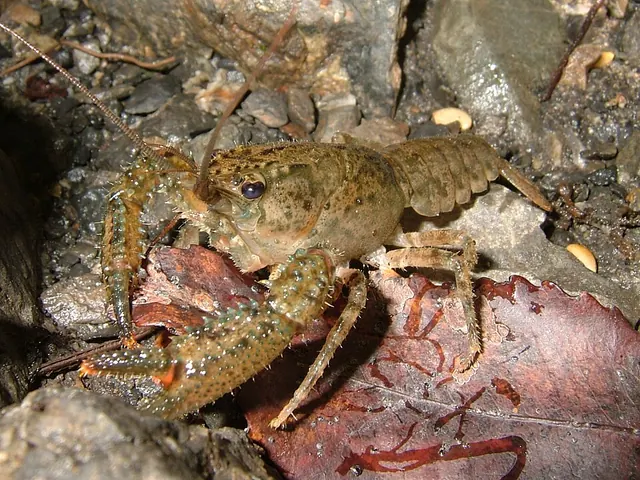
The freshwater crayfish is a crustacean whose activity depends strongly on water temperature; it takes refuge in caves in the heat, competes for caves, and comes out to feed when the temperature is moderate.
Initialization
Random.
Update mechanism
The phase is chosen by the temperature.
Exploration
The competition phase.
Exploitation
Summer resort and foraging around the best.
Mathematical description
A random temperature temp is generated; if it exceeds 30, the crayfish enters the summer resort phase (approaching the cave = the mean of the local and global best) or the competition phase (according to a probability), otherwise it enters the foraging phase, where the amount of food p is computed with a normal distribution around the optimal temperature, and it decides whether to shred the food or eat it directly.
Amount of food
p = C_1\cdot\frac{1}{\sqrt{2\pi}\,\sigma}\exp\!\left(-\frac{(temp-\mu)^2}{2\sigma^2}\right)μ is the optimal temperature (25), C1 and σ constants from the paper.
Computational complexity: O(T\cdot N\cdot (D + C_f))
Pseudocode
Initialize
for t = 1..T:
temp = rand*15 + 20
if temp > 30: summer resort (rand < 0.5) or competition
else: foraging with food intake p(temp)
update bests
return bestPython implementation
There is currently no tested python implementation of this algorithm in the lab. We did not include untested code so that it is not used as a reference implementation.
Coefficients
| Parameter | Symbol | Typical value | Range | Description |
|---|---|---|---|---|
| μ | \mu | 25 | Optimal temperature | |
| C1 | C_1 | 0.2 |
Advantages
A non-linear phase-switching mechanism inspired by a single environmental variable.
Limitations
Several constants (C1, C2, μ, σ) set empirically.
Use in artificial intelligence
Domains documented in the card: Machine learning, hyperparameter tuning
Continuous and engineering optimization.
Hybridization potential
No hybridization partners recorded in the card.
Applied research from the repository
An aspect that did not appear in the current search results within the repository. This does not mean there is no published research outside it.
Original reference
Heming Jia; Honghua Rao; Changsheng Wen; Seyedali Mirjalili (2023). Crayfish optimization algorithm. Artificial Intelligence Review, Springer Science and Business Media LLC.
Verified DOI: 10.1007/s10462-023-10567-4
The bibliographic data match the Crossref record (checked 2026-11-20). There is no tested Python code for this algorithm in this version.
