Elk Herd Optimizer
Elk Herd Optimizer (EHO)
- Year introduced
- 2024
- Original authors
- Mohammed Azmi Al-Betar; Mohammed A. Awadallah; Malik Shehadeh Braik; Sharif Makhadmeh; Iyad Abu Doush
- Source of inspiration
- Elk
- Search space
- Continuous
- Optimization types
- Hyperparameter Optimization
- Applied research in the repository
- 0
Overview
An algorithm inspired by the breeding process of an elk herd, with two seasons: the rutting season (Rutting), when the herd splits into families around the strongest males, and the calving season (Calving), when each family produces new calves. Then a selection season merges everyone and keeps the fittest.
Source of inspiration and mechanism
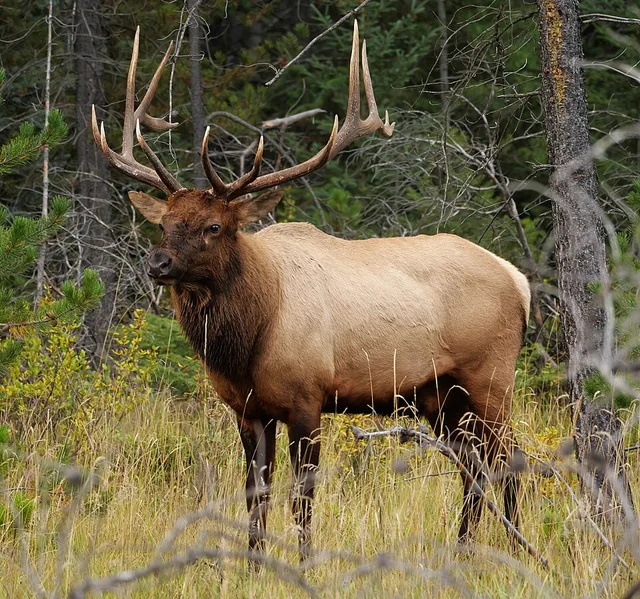
In the rutting season the males fight for dominance, and the strongest forms a family with a larger number of females. In the calving season each family produces calves from its male and females. Scientific name: Cervus canadensis.
Initialization
Uniform random distribution inside the bounds of the search space.
Update mechanism
Splitting into families, then producing, then selection (μ+λ).
Exploration
Producing calves from different followers.
Exploitation
Steering the calves towards strong leaders.
Mathematical description
The population is split into groups, each with one leader (a male) and a number of followers (females) proportional to the leader's fitness. Each group produces new solutions (calves) from its leader and followers. Then the leaders, followers and new solutions are merged and the fittest are chosen to fill the population size.
This algorithm's equations were not included because they have not yet been matched with the original text. See the original reference below.
Computational complexity: O(T\cdot N\cdot (D + C_f))
Flowchart
A simplified chart summarising the algorithm phases as described on its card in the lab; it is not the original figure published in the paper.
Pseudocode
Initialize herd
for t = 1..T:
rutting season: form families (followers proportional to leader fitness)
calving season: generate calves from bull and harems
selection season: merge all and keep the fittest N
return bestPython implementation
There is currently no tested python implementation of this algorithm in the lab. We did not include untested code so that it is not used as a reference implementation.
Coefficients
No parameters recorded.
Advantages
A clear structure close to evolutionary algorithms with several leaders.
Limitations
The number of families is an extra parameter.
Use in artificial intelligence
Domains documented in the card: Machine learning, deep learning, hyperparameter tuning
Continuous optimization and engineering design.
Hybridization potential
These are partnerships suggested theoretically in the card; any resulting design is presented as a "proposed hybrid method" until its results are compared with the literature.
Applied research from the repository
An aspect that did not appear in the current search results within the repository. This does not mean there is no published research outside it.
Original reference
Mohammed Azmi Al-Betar; Mohammed A. Awadallah; Malik Shehadeh Braik; Sharif Makhadmeh; Iyad Abu Doush (2024). Elk herd optimizer: a novel nature-inspired metaheuristic algorithm. Artificial Intelligence Review, Springer Science and Business Media LLC.
Verified DOI: 10.1007/s10462-023-10680-4
External links collected from a search index and from paper abstracts; check that they are the original authors’ code and that they work before relying on them.
The description is based on the published abstract. The bibliographic data match the Crossref record (checked 2026-11-21). There is no tested Python code for this algorithm in this version.