Equilibrium Optimizer
Equilibrium Optimizer (EO)
- Year introduced
- 2020
- Original authors
- Afshin Faramarzi; Mohammad Heidarinejad; Brent Stephens; Seyedali Mirjalili
- Source of inspiration
- Mass balance in a control volume (dynamic equilibrium)
- Search space
- Continuous
- Optimization types
- Hyperparameter Optimization, Feature Selection, Weight Optimization
- Applied research in the repository
- 0
Overview
Inspired by mass balance models in a control volume, used to estimate dynamic and kinetic equilibrium states. Each particle represents a "concentration" that is updated randomly around equilibrium candidates (the four best solutions and their mean) with an exponential term and a generation rate.
Source of inspiration and mechanism
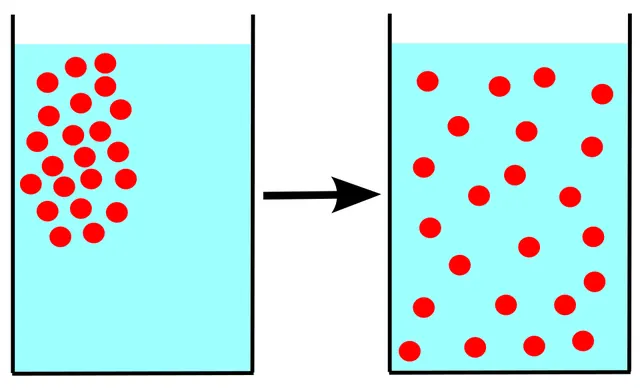
In physics and environmental engineering, the concentration of a non-reactive substance in a control volume is described by a mass balance equation: what enters − what leaves + what is generated. Over time the concentration reaches an equilibrium state.
Initialization
Uniform random concentrations inside the bounds.
Update mechanism
A discrete mass balance equation for each particle, with memory saving.
Exploration
The coefficient a1 = 2 enlarges the jumps, and the sign(r − 0.5) term changes the direction.
Exploitation
Decreasing t reduces F gradually, so the particle settles near the equilibrium candidate; the G term improves exploitation.
Mathematical description
The equilibrium pool C_eq,pool holds the four best solutions and their mean, and a C_eq is chosen from it at random for each particle. The exponential term is F = a1·sign(r − 0.5)(e^{−λt} − 1), where t = (1 − iter/T)^{a2·iter/T}. The generation rate G is applied with probability GP = 0.5. Memory saving (greedy acceptance) is used.
Concentration update
\vec{C} = \vec{C}_{eq} + \left(\vec{C} - \vec{C}_{eq}\right)\cdot\vec{F} + \frac{\vec{G}}{\vec{\lambda} V}\left(1 - \vec{F}\right)V = 1 is a unit volume.
Exponential factor
\vec{F} = a_1\,\mathrm{sign}(\vec{r} - 0.5)\left(e^{-\vec{\lambda} t} - 1\right),\quad t = \left(1-\frac{Iter}{Max\_iter}\right)^{\left(a_2\frac{Iter}{Max\_iter}\right)}a1 = 2, a2 = 1.
Generation rate
\vec{G} = \vec{GCP}\left(\vec{C}_{eq} - \vec{\lambda}\vec{C}\right)\vec{F},\quad GCP = \begin{cases}0.5\,r_1 & r_2 \ge GP\\ 0 & r_2 < GP\end{cases}GP = 0.5.
Computational complexity: O(T\cdot N\cdot (D + C_f))
Pseudocode
Initialize concentrations C
for it = 1..T:
Ceq_pool = {Ceq1..Ceq4, mean}
t = (1 - it/T)^(a2*it/T)
for each particle: Ceq = random from pool; lambda, r random
F = a1*sign(r - 0.5)*(exp(-lambda*t) - 1)
GCP = 0.5*r1 if r2 >= GP else 0; G = GCP*(Ceq - lambda*C)*F
C = Ceq + (C - Ceq)*F + G/(lambda*V)*(1 - F)
memory saving
return Ceq1Python implementation
There is currently no tested python implementation of this algorithm in the lab. We did not include untested code so that it is not used as a reference implementation.
Coefficients
| Parameter | Symbol | Typical value | Range | Description |
|---|---|---|---|---|
| a1 | a_1 | 2 | 1–3 | Exploration ability |
| a2 | a_2 | 1 | 0.5–2 | Exploitation ability |
| Generation probability | GP | 0.5 |
Advantages
- Few parameters (a1, a2, GP)
- Strong, stable performance in many comparison studies
- Uses more than one leader.
Limitations
- A somewhat abstract physical interpretation
- Performance depends on a1 and a2.
Use in artificial intelligence
Domains documented in the card: Machine learning, deep learning, Feature Selection, hyperparameter tuning
Continuous and engineering optimization, hyperparameter tuning, feature selection with binary versions.
Hybridization potential
These are partnerships suggested theoretically in the card; any resulting design is presented as a "proposed hybrid method" until its results are compared with the literature.
Applied research from the repository
An aspect that did not appear in the current search results within the repository. This does not mean there is no published research outside it.
Original reference
Afshin Faramarzi; Mohammad Heidarinejad; Brent Stephens; Seyedali Mirjalili (2020). Equilibrium optimizer: A novel optimization algorithm. Knowledge-Based Systems, Elsevier BV.
Verified DOI: 10.1016/j.knosys.2019.105190
The bibliographic data match the Crossref record (checked 2026-11-20). There is no tested Python code for this algorithm in this version.
