Emperor Penguin Optimizer
Emperor Penguin Optimizer (EPO)
- Year introduced
- 2018
- Original authors
- Gaurav Dhiman; Vijay Kumar
- Source of inspiration
- Emperor penguin huddling
- Search space
- Continuous
- Optimization types
- Hyperparameter Optimization
- Applied research in the repository
- 0
Overview
It imitates the huddling behaviour of emperor penguins, which keeps them warm in the Antarctic winter. The huddle boundary is set, a temperature profile around the huddle is computed, then the distances between the penguins, and finally each penguin moves towards the "effective mover" (the best).
Source of inspiration and mechanism
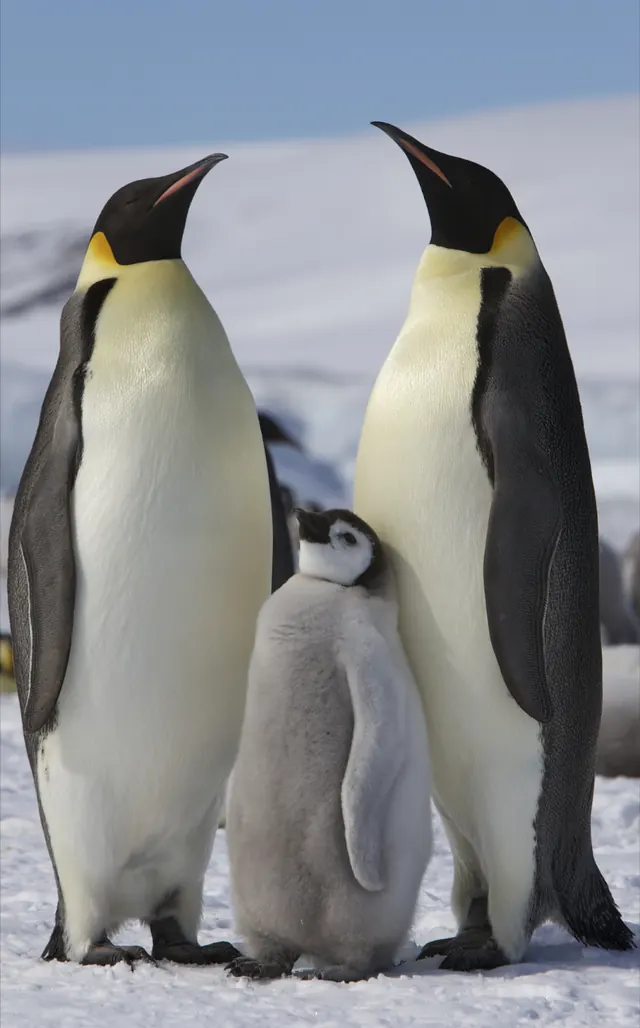
Emperor penguins pack into tight huddles to reduce heat loss, and individuals keep swapping places between the cold edge and the warm centre.
Initialization
Random.
Update mechanism
An update towards the best after computing the temperature profile and the distance.
Exploration
The temperature profile and the random component in A.
Exploitation
Moving towards the best penguin.
Mathematical description
A temperature profile T′ that depends on the huddle radius and the iteration is defined, then the collision-avoidance vectors A and C, the social forces S(A) = (√(f e^{−x/l} − e^{−x}))² and the distance to the best penguin are computed, and the position is updated by subtracting A·D from the best position.
This algorithm's equations were not included because they have not yet been matched with the original text. See the original reference below.
Computational complexity: O(T\cdot N\cdot (D + C_f))
Flowchart
A simplified chart summarising the algorithm phases as described on its card in the lab; it is not the original figure published in the paper.
Pseudocode
Initialize
for t = 1..T:
compute huddle boundary and temperature profile T'
compute A, C, S(A) and distance D to best
P = P_best - A*D
return bestPython implementation
There is currently no tested python implementation of this algorithm in the lab. We did not include untested code so that it is not used as a reference implementation.
Coefficients
| Parameter | Symbol | Typical value | Range | Description |
|---|---|---|---|---|
| Population | N | 80 | ||
| f, l | f, l | 2–3, 1.5–2 | The two social force coefficients |
Advantages
A strong exploitation mechanism around the best.
Limitations
- Equation structure close to GWO
- A number of empirically chosen parameters.
Use in artificial intelligence
Domains documented in the card: Machine learning, hyperparameter tuning
Constrained engineering problems, continuous optimization.
Hybridization potential
These are partnerships suggested theoretically in the card; any resulting design is presented as a "proposed hybrid method" until its results are compared with the literature.
Applied research from the repository
An aspect that did not appear in the current search results within the repository. This does not mean there is no published research outside it.
Original reference
Gaurav Dhiman; Vijay Kumar (2018). Emperor penguin optimizer: A bio-inspired algorithm for engineering problems. Knowledge-Based Systems, Elsevier BV.
Verified DOI: 10.1016/j.knosys.2018.06.001
The bibliographic data match the Crossref record (checked 2026-11-20). There is no tested Python code for this algorithm in this version.
