Energy Valley Optimizer
Energy Valley Optimizer (EVO)
- Year introduced
- 2023
- Original authors
- Mahdi Azizi; Uwe Aickelin; Hadi A. Khorshidi; Milad Baghalzadeh Shishehgarkhaneh
- Source of inspiration
- Radioactive decay and the nuclear band of stability
- Search space
- Continuous
- Optimization types
- Hyperparameter Optimization
- Applied research in the repository
- 0
Overview
Inspired by the principles of stability and the radioactive decay modes of particles (alpha, beta and gamma). Each solution is a "particle" with a stability level, and unstable particles decay by emitting rays, so they move towards the "band of stability" (the best solutions).
Source of inspiration and mechanism
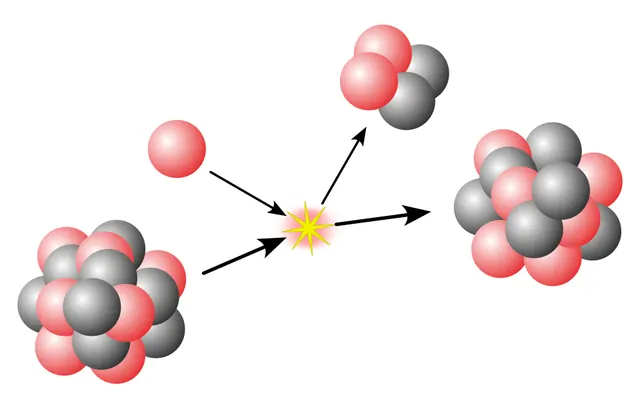
In nuclear physics, stable nuclei lie within the "band of stability" on the chart of nuclides, and unstable nuclei decay by emitting alpha or beta particles or gamma rays to approach stability.
Initialization
Random.
Update mechanism
Generating candidates, then choosing the best.
Exploration
Alpha and gamma decay through dimension exchange.
Exploitation
Beta decay towards the best and the centre of the particles.
Mathematical description
An "enrichment bound" is computed as the mean fitness of the population, along with the stability level of each particle. If the particle is above the enrichment bound, it undergoes alpha or gamma decay (exchanging dimensions with the best or a neighbour) or beta decay (moving towards the centre of the particles and the best). Otherwise it makes a small random move.
This algorithm's equations were not included because they have not yet been matched with the original text. See the original reference below.
Computational complexity: O(T\cdot N\cdot (D + C_f))
Flowchart
A simplified chart summarising the algorithm phases as described on its card in the lab; it is not the original figure published in the paper.
Pseudocode
Initialize particles
for t = 1..T:
EB = mean fitness; compute stability level SL
for each particle:
if NEL > EB: alpha/gamma decay (two new candidates) or beta decay
else: drift with random step
keep best N
return bestPython implementation
There is currently no tested python implementation of this algorithm in the lab. We did not include untested code so that it is not used as a reference implementation.
Coefficients
| Parameter | Symbol | Typical value | Range | Description |
|---|---|---|---|---|
| Population | N | 50 |
Advantages
Almost no tuning parameters.
Limitations
It generates two or more candidates per particle, so the number of evaluations grows.
Use in artificial intelligence
Domains documented in the card: Machine learning, hyperparameter tuning
Continuous and engineering optimization.
Hybridization potential
No hybridization partners recorded in the card.
Applied research from the repository
An aspect that did not appear in the current search results within the repository. This does not mean there is no published research outside it.
Original reference
Mahdi Azizi; Uwe Aickelin; Hadi A. Khorshidi; Milad Baghalzadeh Shishehgarkhaneh (2023). Energy valley optimizer: a novel metaheuristic algorithm for global and engineering optimization. Scientific Reports, Springer Science and Business Media LLC.
Verified DOI: 10.1038/s41598-022-27344-y
External links collected from a search index and from paper abstracts; check that they are the original authors’ code and that they work before relying on them.
The bibliographic data match the Crossref record (checked 2026-11-20). There is no tested Python code for this algorithm in this version.