Frilled Lizard Optimization
Frilled Lizard Optimization (FLO)
- Year introduced
- 2024
- Original authors
- Ibraheem Abu Falahah; Osama Al-Baik; Saleh Alomari; Gulnara Bektemyssova; Saikat Gochhait; Irina Leonova; Om Parkash Malik; Frank Werner; Mohammad Dehghani
- Source of inspiration
- Frilled lizard
- Search space
- Continuous
- Optimization types
- Hyperparameter Optimization
- Applied research in the repository
- 0
Overview
An algorithm that imitates the "sit-and-wait" hunting strategy of the frilled lizard. It has two phases: exploration, which imitates its sudden attack on the prey, and exploitation, which imitates its return to the top of the tree after feeding.
Source of inspiration and mechanism
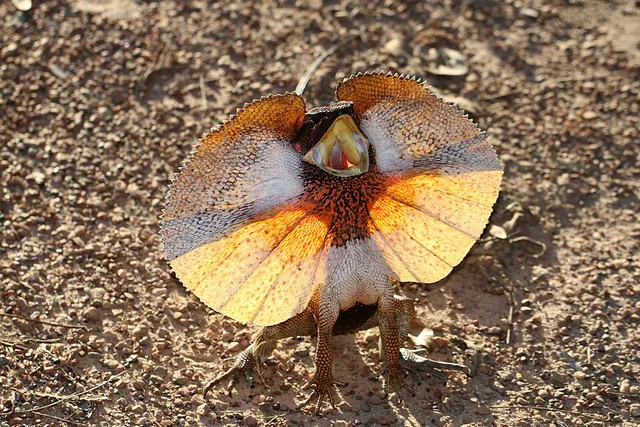
The frilled lizard waits on tree trunks, then pounces on insects and small animals on the ground, and afterwards returns to the tree. It is known for spreading the skin frill around its neck when threatened. Scientific name: Chlamydosaurus kingii.
Initialization
Uniform random distribution inside the bounds of the search space.
Update mechanism
Two successive phases with greedy acceptance after each.
Exploration
Attacking a better individual chosen at random.
Exploitation
A local step that shrinks over time.
Mathematical description
In exploration each individual chooses a "prey" from among the individuals better than it and jumps towards it. In exploitation it makes a small move around its position with a step inversely proportional to the iteration number. The new position is accepted greedily after each phase.
Greedy acceptance
X_i \leftarrow \begin{cases} X_i^{new} & F(X_i^{new}) < F(X_i)\\ X_i & \text{otherwise}\end{cases}The new position is accepted only if it improves the objective function value (minimization).
Computational complexity: O(T\cdot N\cdot (D + C_f))
Flowchart
A simplified chart summarising the algorithm phases as described on its card in the lab; it is not the original figure published in the paper.
Pseudocode
Initialize
for t = 1..T:
for each lizard i:
phase 1: attack a randomly chosen better member (prey)
greedy selection
phase 2: climb back to the tree (local step ~ 1/t)
greedy selection
return bestPython implementation
There is currently no tested python implementation of this algorithm in the lab. We did not include untested code so that it is not used as a reference implementation.
Coefficients
No parameters recorded.
Advantages
- No specific parameters
- Tested on 22 constrained problems from CEC 2011.
Limitations
Two evaluations per individual in each iteration.
Use in artificial intelligence
Domains documented in the card: Machine learning, deep learning, hyperparameter tuning
Continuous and constrained optimization and engineering design.
Hybridization potential
These are partnerships suggested theoretically in the card; any resulting design is presented as a "proposed hybrid method" until its results are compared with the literature.
Applied research from the repository
An aspect that did not appear in the current search results within the repository. This does not mean there is no published research outside it.
Original reference
Ibraheem Abu Falahah; Osama Al-Baik; Saleh Alomari; Gulnara Bektemyssova; Saikat Gochhait; Irina Leonova; Om Parkash Malik; Frank Werner; Mohammad Dehghani (2024). Frilled Lizard Optimization: A Novel Bio-Inspired Optimizer for Solving Engineering Applications. Computers, Materials & Continua, Tech Science Press.
Verified DOI: 10.32604/cmc.2024.053189
External links collected from a search index and from paper abstracts; check that they are the original authors’ code and that they work before relying on them.
The description is based on the published abstract. The bibliographic data match the Crossref record (checked 2026-11-21). There is no tested Python code for this algorithm in this version.