Greylag Goose Optimization
Greylag Goose Optimization (GGO)
- Year introduced
- 2024
- Original authors
- El-Sayed M. El-kenawy; Nima Khodadadi; Seyedali Mirjalili; Abdelaziz A. Abdelhamid; Marwa M. Eid; Abdelhameed Ibrahim
- Source of inspiration
- Greylag goose
- Search space
- Continuous
- Optimization types
- Hyperparameter Optimization, Feature Selection
- Applied research in the repository
- 0
Overview
An algorithm inspired by the collective behaviour of greylag geese during migration and foraging: they fly in a formation in which individuals take turns leading, and some stand guard while the rest feed. The algorithm splits the population into exploration and exploitation groups whose sizes change dynamically.
Source of inspiration and mechanism
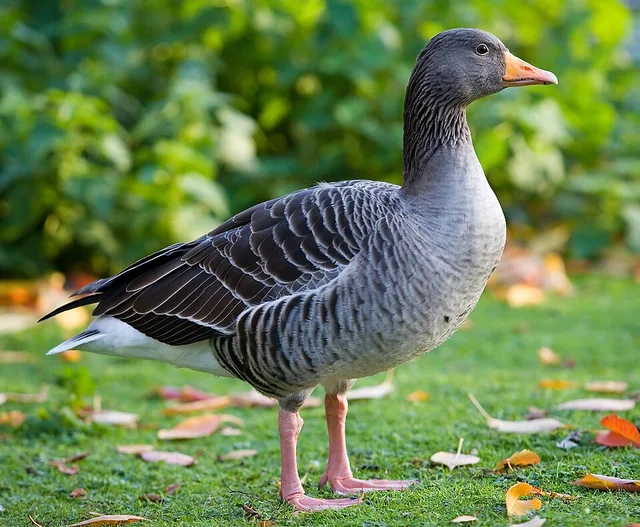
Greylag geese migrate in a V formation that reduces air resistance, and individuals swap the lead position. On the ground the group feeds while some individuals watch the surroundings and raise the alarm. Scientific name: Anser anser.
Initialization
Uniform random distribution inside the bounds of the search space.
Update mechanism
A dynamic split of the population into two groups.
Exploration
The exploration group around random individuals.
Exploitation
The exploitation group around the leaders.
Mathematical description
In each iteration the population is split into an exploration group that moves around random individuals and an exploitation group that moves around the best solutions (the leaders). The sizes of the two groups are adjusted according to the improvement of the best solution: if improvement stalls, the exploration group grows.
This algorithm's equations were not included because they have not yet been matched with the original text. See the original reference below.
Computational complexity: O(T\cdot N\cdot (D + C_f))
Flowchart
A simplified chart summarising the algorithm phases as described on its card in the lab; it is not the original figure published in the paper.
Pseudocode
Initialize; split into exploration and exploitation groups
for t = 1..T:
exploration group: move around random geese
exploitation group: move around leaders
adjust group sizes by best-fitness improvement
return bestPython implementation
There is currently no tested python implementation of this algorithm in the lab. We did not include untested code so that it is not used as a reference implementation.
Coefficients
No parameters recorded.
Advantages
The dynamic split adapts the balance between exploration and exploitation.
Limitations
The comparative results were published by the authors and have not been reproduced experimentally in this encyclopedia.
Use in artificial intelligence
Domains documented in the card: Machine learning, deep learning, Feature Selection, hyperparameter tuning
Continuous optimization and engineering design.
Hybridization potential
These are partnerships suggested theoretically in the card; any resulting design is presented as a "proposed hybrid method" until its results are compared with the literature.
Applied research from the repository
An aspect that did not appear in the current search results within the repository. This does not mean there is no published research outside it.
Original reference
El-Sayed M. El-kenawy; Nima Khodadadi; Seyedali Mirjalili; Abdelaziz A. Abdelhamid; Marwa M. Eid; Abdelhameed Ibrahim (2024). Greylag Goose Optimization: Nature-inspired optimization algorithm. Expert Systems with Applications, Elsevier BV.
Verified DOI: 10.1016/j.eswa.2023.122147
External links collected from a search index and from paper abstracts; check that they are the original authors’ code and that they work before relying on them.
The paper's abstract is not available in Crossref; the description is summarized from the original paper, which contains the detailed equations. The bibliographic data match the Crossref record (checked 2026-11-21). There is no tested Python code for this algorithm in this version.