Grasshopper Optimisation Algorithm
Grasshopper Optimisation Algorithm (GOA)
- Year introduced
- 2017
- Original authors
- Shahrzad Saremi; Seyedali Mirjalili; Andrew Lewis
- Source of inspiration
- Grasshopper swarms
- Search space
- Continuous
- Optimization types
- Hyperparameter Optimization, Feature Selection, Multi-objective Optimization
- Applied research in the repository
- 0
Overview
It imitates the behaviour of grasshopper swarms: nymphs move slowly in small steps, and adults jump long distances. Each grasshopper's position is computed from social interaction forces (attraction and repulsion) with the rest of the swarm plus the direction of the target, with a coefficient c that shrinks to narrow the comfort zone gradually.
Source of inspiration and mechanism
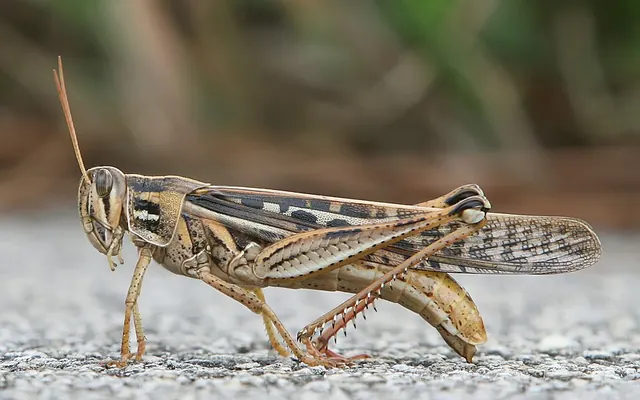
Grasshoppers go through a nymph stage, in which they crawl in groups, and an adult stage, in which they fly and jump long distances. Individuals interact through social forces: repulsion when very close, attraction at medium distances, and a comfort zone between them.
Initialization
Uniform random positions.
Update mechanism
The position is recomputed fully from the interaction forces + the target.
Exploration
A large c at the start widens the interaction zone, so the grasshoppers spread out.
Exploitation
Decreasing c shrinks the comfort zone and gathers the swarm around the target.
Mathematical description
The new position is the sum of the social interaction forces computed with the function s(r) on each dimension after scaling by the range, multiplied by the coefficient c, which shrinks linearly, plus the position of the target (the best solution). There is no velocity; the position is recomputed completely each iteration.
Position update
X_i^d = c\left(\sum_{j\ne i} c\,\frac{ub_d-lb_d}{2}\, s\!\left(|x_j^d-x_i^d|\right)\frac{x_j-x_i}{d_{ij}}\right) + \hat{T}_dT_d is the value of dimension d in the best solution, d_ij the distance between the two grasshoppers.
Social forces function
s(r) = f\,e^{-r/l} - e^{-r},\qquad f=0.5,\ l=1.5f is the attraction intensity and l its characteristic length.
Decreasing coefficient
c = c_{max} - l\,\frac{c_{max}-c_{min}}{L}c_max = 1 and c_min = 0.00001 in the paper.
Computational complexity: O(T\cdot N\cdot (D + C_f))
Pseudocode
Initialize X; target = best
for l = 1..L:
c = cmax - l*(cmax - cmin)/L
for each grasshopper i:
normalize distances; X_i = c * sum_j c*(ub-lb)/2 * s(|x_j - x_i|) * (x_j - x_i)/d_ij + target
clip X_i
update target
return targetPython implementation
There is currently no tested python implementation of this algorithm in the lab. We did not include untested code so that it is not used as a reference implementation.
Coefficients
| Parameter | Symbol | Typical value | Range | Description |
|---|---|---|---|---|
| Population | N | 30 | ||
| c max | c_{max} | 1 | ||
| c min | c_{min} | 0.00001 |
Advantages
- An explicit social mechanism
- One control parameter c
- A multi-objective version (MOGOA) has been published.
Limitations
- Complexity of O(N²) per iteration because of pairwise interaction
- Converges strongly towards the target, which may reduce diversity.
Use in artificial intelligence
Domains documented in the card: Machine learning, deep learning, Feature Selection, hyperparameter tuning
Continuous optimization, structural design, tuning model parameters.
Hybridization potential
These are partnerships suggested theoretically in the card; any resulting design is presented as a "proposed hybrid method" until its results are compared with the literature.
Applied research from the repository
An aspect that did not appear in the current search results within the repository. This does not mean there is no published research outside it.
Original reference
Shahrzad Saremi; Seyedali Mirjalili; Andrew Lewis (2017). Grasshopper Optimisation Algorithm: Theory and application. Advances in Engineering Software, Elsevier BV.
Verified DOI: 10.1016/j.advengsoft.2017.01.004
The bibliographic data match the Crossref record (checked 2026-11-20). There is no tested Python code for this algorithm in this version.
