Honey Badger Algorithm
Honey Badger Algorithm (HBA)
- Year introduced
- 2022
- Original authors
- Fatma A. Hashim; Essam H. Houssein; Kashif Hussain; Mai S. Mabrouk; Walid Al-Atabany
- Source of inspiration
- The honey badger and the honeyguide bird
- Search space
- Continuous
- Optimization types
- Hyperparameter Optimization
- Applied research in the repository
- 0
Overview
It imitates the foraging behaviour of the honey badger: digging guided by its sense of smell (Digging), or following the honeyguide bird (Honey). The smell intensity is inversely proportional to the squared distance, and a density factor α decreases over time.
Source of inspiration and mechanism
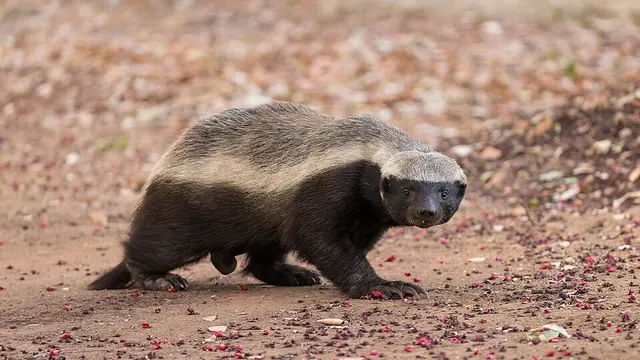
The honey badger is a bold animal that locates its prey by smell and then digs to reach it, and it may follow the honeyguide bird, which leads it to beehives.
Initialization
Random.
Update mechanism
A choice between digging and honey with probability 0.5, with greedy acceptance.
Exploration
The direction flag F and the components of the cardioid path.
Exploitation
Approaching the prey as α decreases.
Mathematical description
The intensity is I = r·S/(4πd²), where S is the source strength and d the distance to the prey (the best solution). In digging the badger moves along a heart-shaped (Cardioid) path around the prey, and in the honey phase it follows the guide directly. F is a ±1 direction flag that flips the direction.
Intensity
I_i = r_2\,\frac{S}{4\pi d_i^2},\quad S = (x_i - x_{i+1})^2,\quad d_i = x_{prey} - x_iDensity factor
\alpha = C\,\exp\!\left(\frac{-t}{t_{max}}\right),\quad C = 2Digging phase
x_{new} = x_{prey} + F\beta I x_{prey} + F r_3 \alpha d_i \left|\cos(2\pi r_4)\left[1-\cos(2\pi r_5)\right]\right|β = 6 is the honey badger's ability to get food.
Honey phase
x_{new} = x_{prey} + F r_7 \alpha d_iComputational complexity: O(T\cdot N\cdot (D + C_f))
Pseudocode
Initialize; x_prey = best
for t = 1..T:
alpha = C*exp(-t/T)
for each badger: compute intensity I_i
if rand < 0.5: digging phase
else: honey phase
accept if better
update x_prey
return x_preyPython implementation
There is currently no tested python implementation of this algorithm in the lab. We did not include untested code so that it is not used as a reference implementation.
Coefficients
| Parameter | Symbol | Typical value | Range | Description |
|---|---|---|---|---|
| β | \beta | 6 | ||
| C | C | 2 |
Advantages
- Few parameters (β = 6, C = 2)
- A smooth transition mechanism.
Limitations
The intensity term may become very large when the solutions converge.
Use in artificial intelligence
Domains documented in the card: Machine learning, hyperparameter tuning
Continuous and engineering optimization.
Hybridization potential
These are partnerships suggested theoretically in the card; any resulting design is presented as a "proposed hybrid method" until its results are compared with the literature.
Applied research from the repository
An aspect that did not appear in the current search results within the repository. This does not mean there is no published research outside it.
Original reference
Fatma A. Hashim; Essam H. Houssein; Kashif Hussain; Mai S. Mabrouk; Walid Al-Atabany (2022). Honey Badger Algorithm: New metaheuristic algorithm for solving optimization problems. Mathematics and Computers in Simulation, Elsevier BV.
Verified DOI: 10.1016/j.matcom.2021.08.013
The bibliographic data match the Crossref record (checked 2026-11-20). There is no tested Python code for this algorithm in this version.
