Hippopotamus Optimization Algorithm
Hippopotamus Optimization Algorithm (HO)
- Year introduced
- 2024
- Original authors
- Mohammad Hussein Amiri; Nastaran Mehrabi Hashjin; Mohsen Montazeri; Seyedali Mirjalili; Nima Khodadadi
- Source of inspiration
- Hippopotamus
- Search space
- Continuous
- Optimization types
- Hyperparameter Optimization
- Applied research in the repository
- 0
Overview
An algorithm that imitates the behaviour of hippopotamuses in three phases: updating their positions in rivers and ponds, defending themselves against predators, and escaping from them. The first phase is for exploration, and the third for exploitation near the current position.
Source of inspiration and mechanism
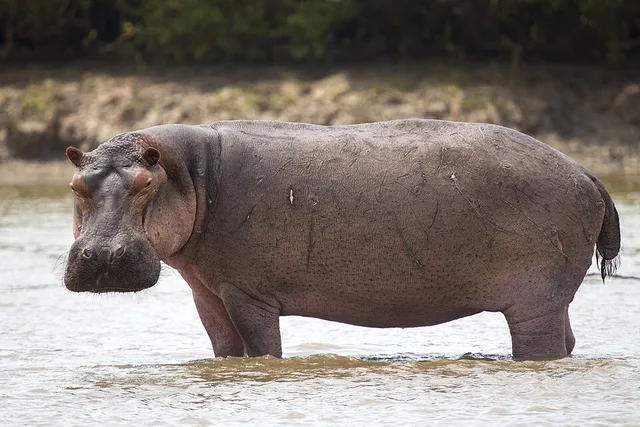
Hippopotamuses live in herds led by a dominant male. They spend most of their time in the water, and an adult faces a predator by turning towards it and opening its mouth, while the young or weak move away to a nearby safe area. Scientific name: Hippopotamus amphibius.
Initialization
Uniform random distribution inside the bounds of the search space.
Update mechanism
Three successive phases for each individual with greedy acceptance.
Exploration
The first and second phases.
Exploitation
The third phase with shrinking local bounds.
Mathematical description
A three-phase model: (1) updating the position in the river or pond by heading towards the dominant male and the mean of a random group of the herd; (2) defending against a predator whose position is generated randomly in the search space; (3) escaping to a nearby safe position with steps that narrow over the iterations. Greedy acceptance is used after each phase.
Greedy acceptance
X_i \leftarrow \begin{cases} X_i^{new} & F(X_i^{new}) < F(X_i)\\ X_i & \text{otherwise}\end{cases}The new position is accepted only if it improves the objective function value (minimization).
Computational complexity: O(T\cdot N\cdot (D + C_f))
Flowchart
A simplified chart summarising the algorithm phases as described on its card in the lab; it is not the original figure published in the paper.
Pseudocode
Initialize herd
for t = 1..T:
phase 1: move in river/pond toward dominant hippo
phase 2: defence against a random predator
phase 3: escape to a nearby safe position (shrinking bounds)
greedy selection after each phase
return dominant hippoPython implementation
There is currently no tested python implementation of this algorithm in the lab. We did not include untested code so that it is not used as a reference implementation.
Coefficients
No parameters recorded.
Advantages
- No specific parameters other than the population size and the number of iterations
- The source code is published.
Limitations
About three evaluations per individual in each iteration, so the cost per iteration is higher.
Use in artificial intelligence
Domains documented in the card: Machine learning, deep learning, hyperparameter tuning
Continuous optimization and constrained engineering design.
Hybridization potential
These are partnerships suggested theoretically in the card; any resulting design is presented as a "proposed hybrid method" until its results are compared with the literature.
Applied research from the repository
An aspect that did not appear in the current search results within the repository. This does not mean there is no published research outside it.
Original reference
Mohammad Hussein Amiri; Nastaran Mehrabi Hashjin; Mohsen Montazeri; Seyedali Mirjalili; Nima Khodadadi (2024). Hippopotamus optimization algorithm: a novel nature-inspired optimization algorithm. Scientific Reports, Springer Science and Business Media LLC.
Verified DOI: 10.1038/s41598-024-54910-3
External links collected from a search index and from paper abstracts; check that they are the original authors’ code and that they work before relying on them.
The description is based on the published abstract. The bibliographic data match the Crossref record (checked 2026-11-21). There is no tested Python code for this algorithm in this version.
