Moth-Flame Optimization
Moth-Flame Optimization (MFO)
- Year introduced
- 2015
- Original authors
- Seyedali Mirjalili
- Source of inspiration
- Transverse orientation of moths around light sources
- Search space
- Continuous
- Optimization types
- Hyperparameter Optimization, Feature Selection
- Applied research in the repository
- 1
Overview
The moths represent the current solutions and the flames the best saved solutions. Each moth spirals around a flame assigned to it, and the number of flames decreases gradually to increase exploitation.
Source of inspiration and mechanism
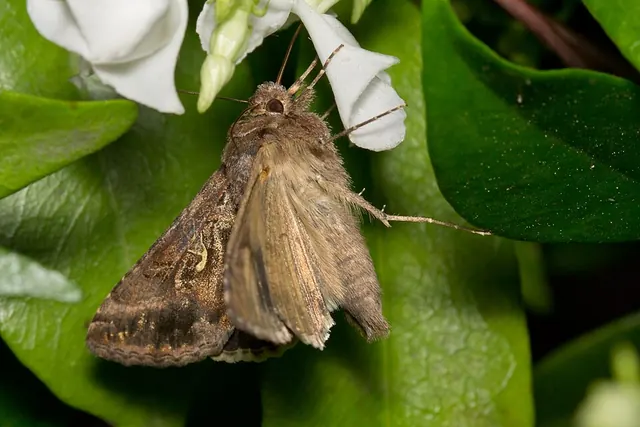
Moths keep a fixed angle to the moon while flying at night, but they circle along a converging spiral around nearby artificial lights.
Initialization
Random moths.
Update mechanism
The moths and flames are merged and sorted in each iteration.
Exploration
t close to 1 gives larger distances around the flame.
Exploitation
Fewer flames and negative values of t.
Mathematical description
Spiral
S(M_i, F_j) = D_i\, e^{b t}\cos(2\pi t) + F_j,\quad D_i = |F_j - M_i|t∈[r,1] and r decreases from −1 to −2.
Number of flames
\text{flame no} = \text{round}\left(N - l\frac{N-1}{T}\right)Computational complexity: O(T\cdot N\log N + T\cdot N\cdot D)
Flowchart
A simplified chart summarising the algorithm phases as described on its card in the lab; it is not the original figure published in the paper.
Pseudocode
Initialize moths M; flames F = sorted(M)
for l = 1..T:
update flame number; r decreases from -1 to -2
for each moth i: assign flame j = min(i, flame_no); move by spiral
F = best N of (F ∪ M)
return F[0]Python implementation
This code was actually run while building the lab (NumPy) on the sphere function to make sure it works; this is a run test, not a performance claim.
import numpy as np
def mfo(f, lb, ub, dim, n=30, iters=200, b=1.0, seed=0):
"""Moth-Flame Optimization (Mirjalili, 2015): logarithmic spiral around a shrinking set of flames."""
rng = np.random.default_rng(seed)
moth = rng.uniform(lb, ub, (n, dim)); Fm = np.apply_along_axis(f, 1, moth)
order = np.argsort(Fm); flames, Ff = moth[order].copy(), Fm[order].copy()
curve = []
for t in range(1, iters + 1):
nflames = round(n - t * (n - 1) / iters)
a = -1 + t * (-1 / iters) # decreases from -1 to -2
for i in range(n):
j = min(i, nflames - 1)
D = np.abs(flames[j] - moth[i])
tt = (a - 1) * rng.random(dim) + 1
moth[i] = D * np.exp(b * tt) * np.cos(2 * np.pi * tt) + flames[j]
moth = np.clip(moth, lb, ub); Fm = np.apply_along_axis(f, 1, moth)
allx = np.vstack([flames, moth]); allf = np.concatenate([Ff, Fm])
order = np.argsort(allf)[:n]; flames, Ff = allx[order], allf[order]
curve.append(Ff[0])
return flames[0], Ff[0], curve
if __name__ == "__main__":
sphere = lambda z: float(np.sum(z ** 2))
best, val, curve = mfo(sphere, -100, 100, dim=10)
print("best fitness:", val)
Coefficients
| Parameter | Symbol | Typical value | Range | Description |
|---|---|---|---|---|
| Spiral constant | b | 1 | ||
| Population | N | 30 |
Advantages
- Few parameters
- Explicitly keeps the best solutions.
Limitations
Reducing the flames may cause premature convergence.
Use in artificial intelligence
Domains documented in the card: Machine learning, Feature Selection, hyperparameter tuning
Continuous optimization, engineering design, parameter tuning.
Hybridization potential
These are partnerships suggested theoretically in the card; any resulting design is presented as a "proposed hybrid method" until its results are compared with the literature.
Applied research from the repository
Original reference
Seyedali Mirjalili (2015). Moth-flame optimization algorithm: A novel nature-inspired heuristic paradigm. Knowledge-Based Systems, Elsevier BV.
Verified DOI: 10.1016/j.knosys.2015.07.006
External links collected from a search index and from paper abstracts; check that they are the original authors’ code and that they work before relying on them.
