Parrot Optimizer
Parrot Optimizer (PO-Pa)
- Year introduced
- 2024
- Original authors
- Junbo Lian; Guohua Hui; Ling Ma; Ting Zhu; Xincan Wu; Ali Asghar Heidari; Yi Chen; Huiling Chen
- Source of inspiration
- Green-cheeked parakeet
- Search space
- Continuous
- Optimization types
- Hyperparameter Optimization, Feature Selection
- Applied research in the repository
- 0
Overview
An algorithm inspired by the behaviours of trained Pyrrhura molinae parrots: foraging, staying near the owner, communicating with the flock, and wariness of strangers. In each iteration each individual picks one of these behaviours at random, so exploration and exploitation are mixed throughout the search.
Source of inspiration and mechanism
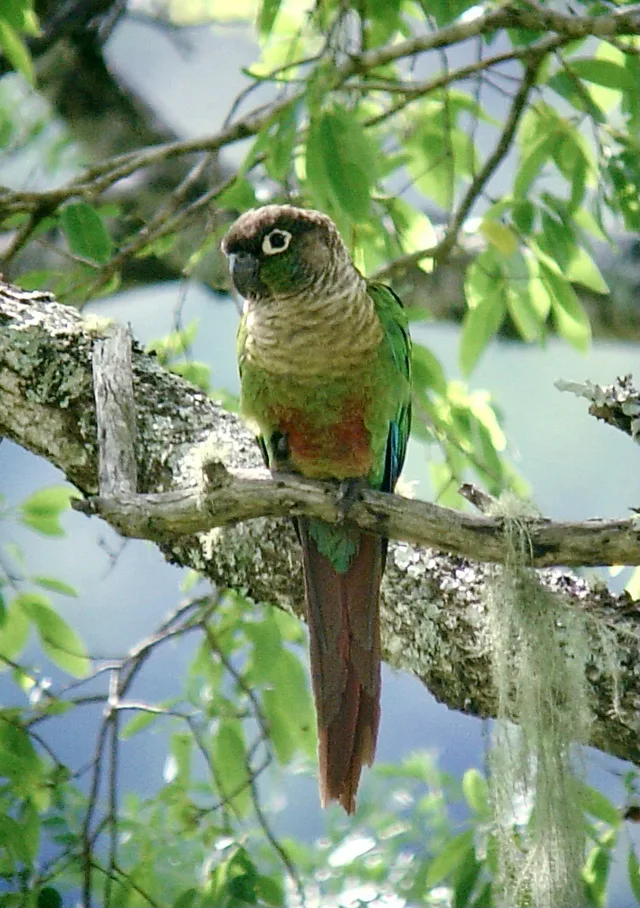
Researchers observed that trained parrots behave in distinct ways: they search for food, fly to their owner and stay on them, communicate with the rest of the flock, and move away from strangers to a safe place near the owner. Scientific name: Pyrrhura molinae.
Initialization
Uniform random distribution inside the bounds of the search space.
Update mechanism
A random choice of one of four behaviours for each individual in each iteration.
Exploration
The foraging and communication behaviours.
Exploitation
The staying and fear-of-strangers behaviours around the best solution.
Mathematical description
The four behaviours are update mechanisms: foraging uses Lévy steps around the best position and the population mean, staying brings the individual closer to the owner (the best solution), communicating brings it closer to or farther from the flock mean, and fear of strangers pushes it away from a random position towards the best. The behaviour is chosen at random for each individual.
This algorithm's equations were not included because they have not yet been matched with the original text. See the original reference below.
Computational complexity: O(T\cdot N\cdot (D + C_f))
Flowchart
A simplified chart summarising the algorithm phases as described on its card in the lab; it is not the original figure published in the paper.
Pseudocode
Initialize
for t = 1..T:
for each parrot i:
St = random behaviour in {foraging, staying, communicating, fear of strangers}
update X_i with the chosen behaviour
update best
return bestPython implementation
There is currently no tested python implementation of this algorithm in the lab. We did not include untested code so that it is not used as a reference implementation.
Coefficients
No parameters recorded.
Advantages
- Simple to implement and open source
- Tested in disease diagnosis and medical image segmentation.
Limitations
The random choice of behaviour may slow convergence on some unimodal functions.
Use in artificial intelligence
Domains documented in the card: Machine learning, deep learning, Feature Selection, hyperparameter tuning
Continuous optimization, and medical applications such as threshold-based medical image segmentation.
Hybridization potential
These are partnerships suggested theoretically in the card; any resulting design is presented as a "proposed hybrid method" until its results are compared with the literature.
Applied research from the repository
An aspect that did not appear in the current search results within the repository. This does not mean there is no published research outside it.
Original reference
Junbo Lian; Guohua Hui; Ling Ma; Ting Zhu; Xincan Wu; Ali Asghar Heidari; Yi Chen; Huiling Chen (2024). Parrot optimizer: Algorithm and applications to medical problems. Computers in Biology and Medicine, Elsevier BV.
Verified DOI: 10.1016/j.compbiomed.2024.108064
External links collected from a search index and from paper abstracts; check that they are the original authors’ code and that they work before relying on them.
The abbreviation in the paper is PO, which it shares with the Political Optimizer in the encyclopedia and with the Puma Optimizer; so it is distinguished here as PO-Pa. The paper's abstract is not available in Crossref; the description is summarized from the original paper, which contains the detailed equations. The bibliographic data match the Crossref record (checked 2026-11-21). There is no tested Python code for this algorithm in this version.