Polar Lights Optimizer
Polar Lights Optimizer (PLO)
- Year introduced
- 2024
- Original authors
- Chong Yuan; Dong Zhao; Ali Asghar Heidari; Lei Liu; Yi Chen; Huiling Chen
- Source of inspiration
- Aurora
- Search space
- Continuous
- Optimization types
- Hyperparameter Optimization, Feature Selection
- Applied research in the repository
- 0
Overview
An algorithm inspired by the physics of the aurora: the spiral motion of charged particles around magnetic field lines, their movement along the auroral oval, and their collisions with other particles. Its authors applied it to image segmentation and feature selection.
Source of inspiration and mechanism
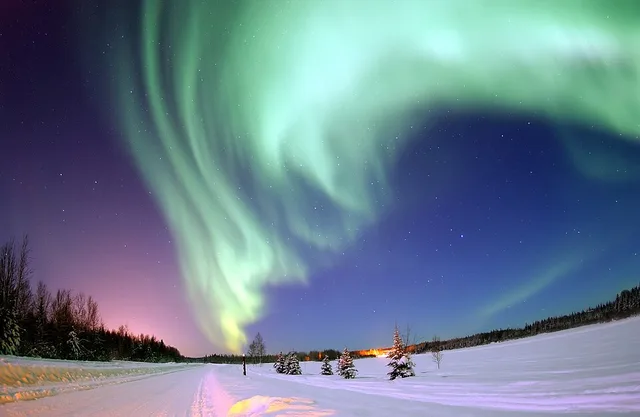
Charged solar wind particles enter the Earth's magnetic field and spiral around its lines, move towards the poles along an oval region, and then collide with atoms of the atmosphere and emit light. Scientific name: Aurora.
Initialization
Uniform random distribution inside the bounds of the search space.
Update mechanism
A weighted mix of two motions with collision.
Exploration
Walking along the auroral oval and particle collision.
Exploitation
Spiral motion around the best solution.
Mathematical description
The spiral motion (Gyration) provides local exploitation with steps that decrease over time, and walking along the auroral oval provides exploration with Lévy motion. The two motions are balanced with weights that change over the iterations. The particle collision strategy swaps dimensions with values from a random particle to avoid local optima.
This algorithm's equations were not included because they have not yet been matched with the original text. See the original reference below.
Computational complexity: O(T\cdot N\cdot (D + C_f))
Pseudocode
Initialize
for t = 1..T:
for each particle i:
gyration motion (local) + aurora-oval walk (global), weighted
particle collision on random dimensions
greedy selection
return bestPython implementation
There is currently no tested python implementation of this algorithm in the lab. We did not include untested code so that it is not used as a reference implementation.
Coefficients
No parameters recorded.
Advantages
Applied to multi-threshold image segmentation and feature selection.
Limitations
The comparative results were published by the authors and have not been reproduced experimentally in this encyclopedia.
Use in artificial intelligence
Domains documented in the card: Machine learning, deep learning, Feature Selection, hyperparameter tuning
Threshold-based image segmentation, feature selection, and continuous optimization.
Hybridization potential
These are partnerships suggested theoretically in the card; any resulting design is presented as a "proposed hybrid method" until its results are compared with the literature.
Applied research from the repository
An aspect that did not appear in the current search results within the repository. This does not mean there is no published research outside it.
Original reference
Chong Yuan; Dong Zhao; Ali Asghar Heidari; Lei Liu; Yi Chen; Huiling Chen (2024). Polar lights optimizer: Algorithm and applications in image segmentation and feature selection. Neurocomputing, Elsevier BV.
Verified DOI: 10.1016/j.neucom.2024.128427
The paper's abstract is not available in Crossref; the description is summarized from the original paper, which contains the detailed equations. The bibliographic data match the Crossref record (checked 2026-11-21). There is no tested Python code for this algorithm in this version.
