Pelican Optimization Algorithm
Pelican Optimization Algorithm (POA)
- Year introduced
- 2022
- Original authors
- Pavel Trojovský; Mohammad Dehghani
- Source of inspiration
- Pelicans and fishing
- Search space
- Continuous
- Optimization types
- Hyperparameter Optimization
- Applied research in the repository
- 0
Overview
It imitates the hunting strategy of pelicans: a phase of approaching the prey (exploration), in which the prey's position is generated randomly and the pelican moves towards or away from it, and a phase of flying on the water surface (exploitation), with movement inside a neighbourhood that shrinks over time.
Source of inspiration and mechanism
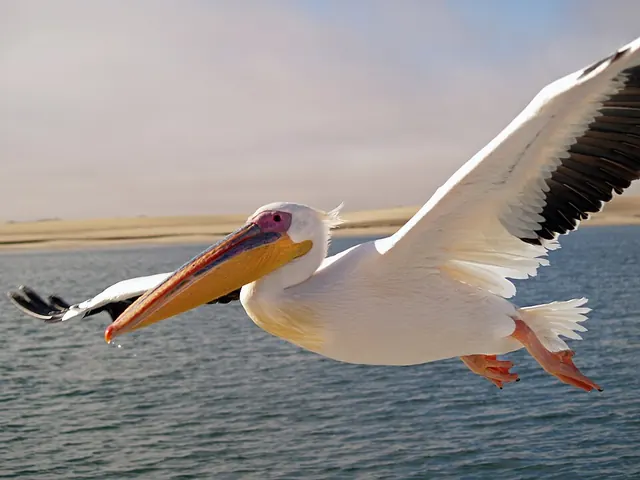
The pelican locates fish from the air and then dives at them; at the water surface it spreads its wings to push the fish into shallow water and scoops them into its throat pouch.
Initialization
Random.
Update mechanism
Two phases with greedy acceptance.
Exploration
The first phase with a random prey position.
Exploitation
The second phase with a shrinking neighbourhood.
Mathematical description
In the first phase a random prey position P is chosen; if its fitness is better, the pelican moves towards it, x + r(P − I·x), otherwise it moves away from it. In the second phase x + R(1 − t/T)(2r − 1)x with R = 0.2. Each update is accepted greedily.
Approaching the prey
x_{i,j}^{P_1} = \begin{cases}x_{i,j} + r(p_j - I\,x_{i,j}) & F_p < F_i\\ x_{i,j} + r(x_{i,j} - p_j) & \text{otherwise}\end{cases}I is a random number from {1,2}.
Flying on the water surface
x_{i,j}^{P_2} = x_{i,j} + R\left(1-\frac{t}{T}\right)(2r-1)\,x_{i,j},\quad R=0.2Computational complexity: O(T\cdot N\cdot (D + C_f))
Pseudocode
Initialize
for t = 1..T:
P = random prey position
for each pelican:
phase 1: move toward/away from P; accept if better
phase 2: x_new = x + R*(1 - t/T)*(2r - 1)*x; accept if better
return bestPython implementation
There is currently no tested python implementation of this algorithm in the lab. We did not include untested code so that it is not used as a reference implementation.
Coefficients
| Parameter | Symbol | Typical value | Range | Description |
|---|---|---|---|---|
| Population | N | 30 |
Advantages
- Almost no tuning parameters
- Easy to implement.
Limitations
- The second phase is proportional to x, so it is biased towards the origin
- Its mechanism is close to NGO by the same authors.
Use in artificial intelligence
Domains documented in the card: Machine learning, hyperparameter tuning
Continuous and engineering optimization.
Hybridization potential
These are partnerships suggested theoretically in the card; any resulting design is presented as a "proposed hybrid method" until its results are compared with the literature.
Applied research from the repository
An aspect that did not appear in the current search results within the repository. This does not mean there is no published research outside it.
Original reference
Pavel Trojovský; Mohammad Dehghani (2022). Pelican Optimization Algorithm: A Novel Nature-Inspired Algorithm for Engineering Applications. Sensors, MDPI AG.
Verified DOI: 10.3390/s22030855
The bibliographic data match the Crossref record (checked 2026-11-20). There is no tested Python code for this algorithm in this version.
