Philoponella prominens Optimizer
Philoponella prominens Optimizer (PPO)
- Year introduced
- 2025
- Original authors
- Yuansheng Gao; Jinpeng Wang; Changlin Li
- Source of inspiration
- The spider Philoponella prominens
- Search space
- Continuous
- Optimization types
- Hyperparameter Optimization
- Applied research in the repository
- 0
Overview
An algorithm inspired by the unique mating behaviour of the spider Philoponella prominens, whose male catapults himself away right after mating to avoid being eaten by the female. The algorithm imitates the males' escape, sexual cannibalism and predation. Its authors applied it to 3D path planning.
Source of inspiration and mechanism
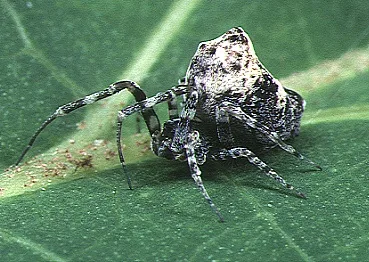
It was observed that the male of this spider launches himself away from the female at great speed after mating, using the joint of his front legs, and a male that fails to jump may be eaten by the female.
Initialization
Uniform random distribution inside the bounds of the search space.
Update mechanism
Three successive mechanisms.
Exploration
Escape jumps after mating.
Exploitation
Predation around the best solution.
Mathematical description
The first step (escape) throws the solution far away with a big jump (exploration), the second step (sexual cannibalism) replaces weak solutions, and the third (predation) brings solutions closer to the best solution (exploitation).
This algorithm's equations were not included because they have not yet been matched with the original text. See the original reference below.
Computational complexity: O(T\cdot N\cdot (D + C_f))
Pseudocode
Initialize
for t = 1..T:
escape behaviour (large jumps)
sexual cannibalism (replace weak solutions)
predation (move toward best)
return bestPython implementation
There is currently no tested python implementation of this algorithm in the lab. We did not include untested code so that it is not used as a reference implementation.
Coefficients
No parameters recorded.
Advantages
Tested on 3D path planning.
Limitations
The comparative results were published by the authors and have not been reproduced experimentally in this encyclopedia.
Use in artificial intelligence
Domains documented in the card: Machine learning, deep learning, hyperparameter tuning
Path planning, and continuous optimization.
Hybridization potential
These are partnerships suggested theoretically in the card; any resulting design is presented as a "proposed hybrid method" until its results are compared with the literature.
Applied research from the repository
An aspect that did not appear in the current search results within the repository. This does not mean there is no published research outside it.
Original reference
Yuansheng Gao; Jinpeng Wang; Changlin Li (2025). Escape after love: Philoponella prominens optimizer and its application to 3D path planning. Cluster Computing, Springer Science and Business Media LLC.
Verified DOI: 10.1007/s10586-024-04761-4
Published online on 2024-11-26 in the journal's 2025 volume. The paper's abstract is not available in Crossref; the description is based on the brief Semantic Scholar summary and the paper's title, and the mathematical details are in the original paper. The bibliographic data match the Crossref record (checked 2026-11-21). There is no tested Python code for this algorithm in this version.
