Slime Mould Algorithm
Slime Mould Algorithm (SMA)
- Year introduced
- 2020
- Original authors
- Shimin Li; Huiling Chen; Mingjing Wang; Ali Asghar Heidari; Seyedali Mirjalili
- Source of inspiration
- The oscillation of the slime mould Physarum polycephalum while foraging
- Search space
- Continuous
- Optimization types
- Hyperparameter Optimization, Feature Selection
- Applied research in the repository
- 0
Overview
Positions are updated with adaptive weights derived from the fitness ranking, choosing between random search and approaching the best position with a probability that depends on fitness.
Source of inspiration and mechanism
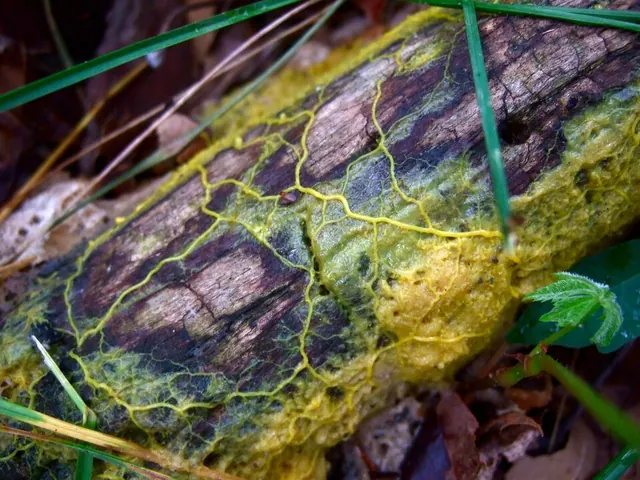
The slime mould spreads a network of tubes and strengthens it towards the richest food sources through positive and negative feedback. It was added to replace a duplicate of the Salp Swarm Algorithm in the original list.
Initialization
Random.
Update mechanism
Adaptive weights.
Exploration
The probability z and v_b.
Exploitation
The decreasing v_c.
Mathematical description
Update
X(t+1) = \begin{cases} X_b(t) + v_b\,(W\cdot X_A(t) - X_B(t)) & r<p\\ v_c\cdot X(t) & r\ge p\end{cases}W is an adaptive weight, v_b∈[−a,a], v_c decreases to 0.
Computational complexity: O(T\cdot N\cdot (D + \log N))
Flowchart
A simplified chart summarising the algorithm phases as described on its card in the lab; it is not the original figure published in the paper.
Pseudocode
Initialize
for t = 1..T:
compute fitness ranks and weights W; update p, vb, vc
with small prob z: random position; else apply update rule
return bestPython implementation
There is currently no tested python implementation of this algorithm in the lab. We did not include untested code so that it is not used as a reference implementation.
Coefficients
| Parameter | Symbol | Typical value | Range | Description |
|---|---|---|---|---|
| z | z | 0.03 |
Advantages
Competitive performance in published studies.
Limitations
A relatively complex formulation.
Use in artificial intelligence
Domains documented in the card: Machine learning, Feature Selection, hyperparameter tuning
Continuous optimization, parameter tuning.
Hybridization potential
These are partnerships suggested theoretically in the card; any resulting design is presented as a "proposed hybrid method" until its results are compared with the literature.
Applied research from the repository
An aspect that did not appear in the current search results within the repository. This does not mean there is no published research outside it.
Original reference
Shimin Li; Huiling Chen; Mingjing Wang; Ali Asghar Heidari; Seyedali Mirjalili (2020). Slime mould algorithm: A new method for stochastic optimization. Future Generation Computer Systems, Elsevier BV.
Verified DOI: 10.1016/j.future.2020.03.055
External links collected from a search index and from paper abstracts; check that they are the original authors’ code and that they work before relying on them.
There is no tested Python code for this algorithm in this version.
