Seagull Optimization Algorithm
Seagull Optimization Algorithm (SOA)
- Year introduced
- 2019
- Original authors
- Gaurav Dhiman; Vijay Kumar
- Source of inspiration
- Seagulls
- Search space
- Continuous
- Optimization types
- Hyperparameter Optimization
- Applied research in the repository
- 0
Overview
It imitates the migration and prey attack behaviour of seagulls. During migration the seagulls avoid collisions, move towards the best neighbour and stay close to it (exploration), and during the attack they move in a spiral through the air (exploitation).
Source of inspiration and mechanism
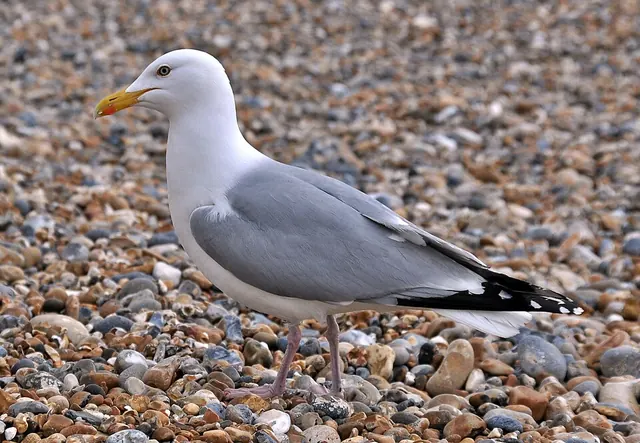
Seagulls migrate in groups from different starting positions to avoid collisions, then attack their prey with a spiral motion in which they keep changing their flight angle and speed.
Initialization
Random.
Update mechanism
A spiral update around the best.
Exploration
Collision avoidance with a large A early on.
Exploitation
The spiral attack around the best seagull.
Mathematical description
A seagull's position is adjusted by a coefficient A that decreases linearly from f_c = 2 to avoid collisions, then it moves towards the best with a coefficient B = 2A²r, the distance D from the best is computed, and the position is updated with spiral coordinates x′y′z′ around the best.
Avoiding collisions
\vec{C}_s = A \times \vec{P}_s(x),\quad A = f_c - x\left(\frac{f_c}{Max_{iter}}\right)f_c = 2.
Movement towards the best
\vec{M}_s = B \times \left(\vec{P}_{bs}(x) - \vec{P}_s(x)\right),\quad B = 2A^2 r_dSpiral attack
\vec{P}_s(x) = \left(\vec{D}_s \times x^{\prime} \times y^{\prime} \times z^{\prime}\right) + \vec{P}_{bs}(x),\quad r = u\,e^{kv}x′ = r cos k, y′ = r sin k and z′ = r k, and u and v are spiral constants.
Computational complexity: O(T\cdot N\cdot (D + C_f))
Flowchart
A simplified chart summarising the algorithm phases as described on its card in the lab; it is not the original figure published in the paper.
Pseudocode
Initialize; Pbs = best
for t = 1..T:
A = fc - t*(fc/T)
for each seagull: C = A*P; M = B*(Pbs - P); D = |C + M|
P = D * x*y*z + Pbs # spiral coordinates
update Pbs
return PbsPython implementation
There is currently no tested python implementation of this algorithm in the lab. We did not include untested code so that it is not used as a reference implementation.
Coefficients
| Parameter | Symbol | Typical value | Range | Description |
|---|---|---|---|---|
| fc | f_c | 2 | ||
| Spiral constants | u, v | 1, 1 |
Advantages
- Simple
- A spiral component similar to WOA.
Limitations
- Strong similarity to the mechanisms of earlier algorithms
- The published performance depends on the paper's settings.
Use in artificial intelligence
Domains documented in the card: Machine learning, hyperparameter tuning
Continuous optimization and large-scale engineering problems.
Hybridization potential
- PSO — Particle Swarm Optimization Design this hybrid
- WOA — Whale Optimization Algorithm Design this hybrid
These are partnerships suggested theoretically in the card; any resulting design is presented as a "proposed hybrid method" until its results are compared with the literature.
Applied research from the repository
An aspect that did not appear in the current search results within the repository. This does not mean there is no published research outside it.
Original reference
Gaurav Dhiman; Vijay Kumar (2019). Seagull optimization algorithm: Theory and its applications for large-scale industrial engineering problems. Knowledge-Based Systems, Elsevier BV.
Verified DOI: 10.1016/j.knosys.2018.11.024
External links collected from a search index and from paper abstracts; check that they are the original authors’ code and that they work before relying on them.
The bibliographic data match the Crossref record (checked 2026-11-20). There is no tested Python code for this algorithm in this version.
