Social Spider Optimization
Social Spider Optimization (SSO)
- Year introduced
- 2013
- Original authors
- Erik Cuevas; Miguel Cienfuegos; Daniel Zaldívar; Marco Pérez-Cisneros
- Source of inspiration
- Social spider colonies
- Search space
- Continuous
- Optimization types
- Hyperparameter Optimization
- Applied research in the repository
- 0
Overview
The population is split into females and males (dominant and non-dominant); the females move according to the vibrations of the nearest better spider and of the best spider, and the dominant males mate with the females within the mating radius.
Source of inspiration and mechanism
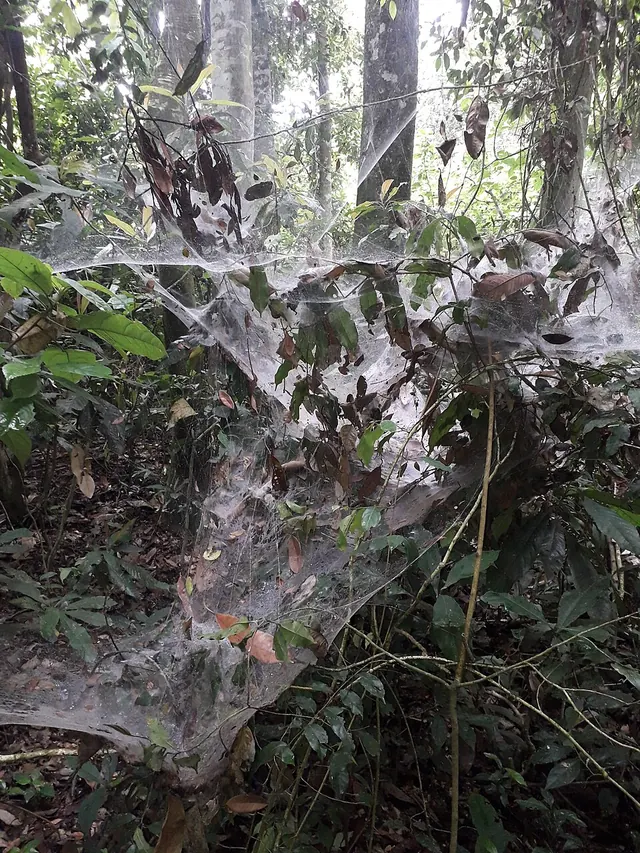
Some spiders live in colonies with a female majority; they communicate through web vibrations, and the dominant males mate.
Initialization
Random.
Update mechanism
Roles by sex.
Exploration
Moving against the vibration with some probability.
Exploitation
Attraction to the heaviest.
Mathematical description
The formulas are simplified.
Vibration
Vib_{i,j} = w_j\, e^{-d_{i,j}^{2}}w_j is the weight of spider j.
Computational complexity: O(T\cdot N^{2}\cdot D)
Flowchart
A simplified chart summarising the algorithm phases as described on its card in the lab; it is not the original figure published in the paper.
Pseudocode
Initialize females and males (females 65-90%)
for t = 1..T:
compute weights; female cooperative operator; male cooperative operator; mating
return bestPython implementation
There is currently no tested python implementation of this algorithm in the lab. We did not include untested code so that it is not used as a reference implementation.
Coefficients
| Parameter | Symbol | Typical value | Range | Description |
|---|---|---|---|---|
| Female ratio | — | 0.65–0.9 | ||
| PF | PF | 0.7 |
Advantages
Diversity thanks to the roles.
Limitations
Quadratic cost and several parameters.
Use in artificial intelligence
Domains documented in the card: Machine learning, hyperparameter tuning
Continuous optimization.
Hybridization potential
These are partnerships suggested theoretically in the card; any resulting design is presented as a "proposed hybrid method" until its results are compared with the literature.
Applied research from the repository
An aspect that did not appear in the current search results within the repository. This does not mean there is no published research outside it.
Original reference
Erik Cuevas; Miguel Cienfuegos; Daniel Zaldívar; Marco Pérez-Cisneros (2013). A swarm optimization algorithm inspired in the behavior of the social-spider. Expert Systems with Applications, Elsevier BV.
Verified DOI: 10.1016/j.eswa.2013.05.041
There is no tested Python code for this algorithm in this version.
