Tree Growth Algorithm
Tree Growth Algorithm (TGA)
- Year introduced
- 2018
- Original authors
- Armin Cheraghalipour; Mostafa Hajiaghaei-Keshteli; Mohammad Mahdi Paydar
- Source of inspiration
- Tree growth and competition for light
- Search space
- Continuous
- Optimization types
- Hyperparameter Optimization
- Applied research in the repository
- 0
Overview
It imitates the competition of trees in a forest for light and food. The trees are split into four groups: the best grow locally, those competing for light move between the two nearest better trees, the worst are removed and new trees are planted in their place, and a reproduction group produces seeds around the best.
Source of inspiration and mechanism
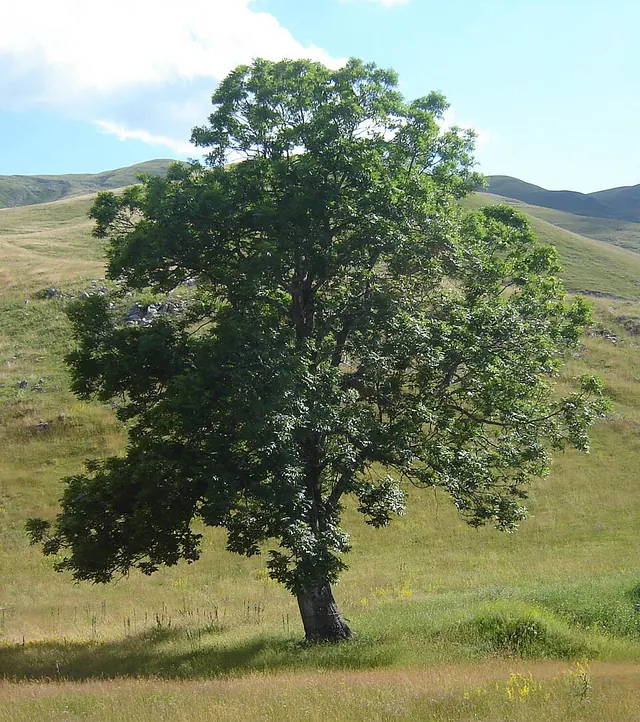
In a forest, large trees grow slowly while benefiting from the light, small trees lean towards the bright gaps between trees, and weak trees die and are replaced by new seedlings.
Initialization
Random.
Update mechanism
Four rules by group.
Exploration
The third group (random replacement).
Exploitation
Local growth of the first group.
Mathematical description
The first group (N1): x_new = x/θ + r·x with a reduction rate θ. The second group (N2): moves towards a linear combination of the two nearest better trees with a coefficient λ. The third group (N3): random replacement. The fourth group (N4): seeds mixed with the best through a random mask.
This algorithm's equations were not included because they have not yet been matched with the original text. See the original reference below.
Computational complexity: O(T\cdot N\cdot (D + C_f))
Pseudocode
Initialize; sort
for t = 1..T:
N1 (best): local growth with reduction rate theta
N2 (competition for light): move between two closest better trees
N3: remove worst, plant new random trees
N4: reproduce around best
merge and sort
return bestPython implementation
There is currently no tested python implementation of this algorithm in the lab. We did not include untested code so that it is not used as a reference implementation.
Coefficients
| Parameter | Symbol | Typical value | Range | Description |
|---|---|---|---|---|
| N1, N2, N4 | N_1,N_2,N_4 | — | Group sizes | |
| θ | \theta | 0.8 | Reduction rate | |
| λ | \lambda | 0.5 |
Advantages
An explicit split of the exploration and exploitation roles.
Limitations
Four group sizes that must be tuned (N1–N4).
Use in artificial intelligence
Domains documented in the card: Machine learning, hyperparameter tuning
Continuous and combinatorial optimization.
Hybridization potential
No hybridization partners recorded in the card.
Applied research from the repository
An aspect that did not appear in the current search results within the repository. This does not mean there is no published research outside it.
Original reference
Armin Cheraghalipour; Mostafa Hajiaghaei-Keshteli; Mohammad Mahdi Paydar (2018). Tree Growth Algorithm (TGA): A novel approach for solving optimization problems. Engineering Applications of Artificial Intelligence, Elsevier BV.
Verified DOI: 10.1016/j.engappai.2018.04.021
The bibliographic data match the Crossref record (checked 2026-11-20). There is no tested Python code for this algorithm in this version.
