Tornado Optimizer with Coriolis Force
Tornado Optimizer with Coriolis Force (TOC)
- Year introduced
- 2025
- Original authors
- Malik Braik; Heba Al-Hiary; Hussein Alzoubi; Abdelaziz Hammouri; Mohammed Azmi Al-Betar; Mohammed A. Awadallah
- Source of inspiration
- The tornado and the Coriolis force
- Search space
- Continuous
- Optimization types
- Hyperparameter Optimization
- Applied research in the repository
- 0
Overview
An algorithm inspired by the tornado cycle: how thunderstorms and windstorms develop into tornadoes through the Coriolis force and then dissipate on land. The Coriolis force is used to balance exploration and exploitation.
Source of inspiration and mechanism
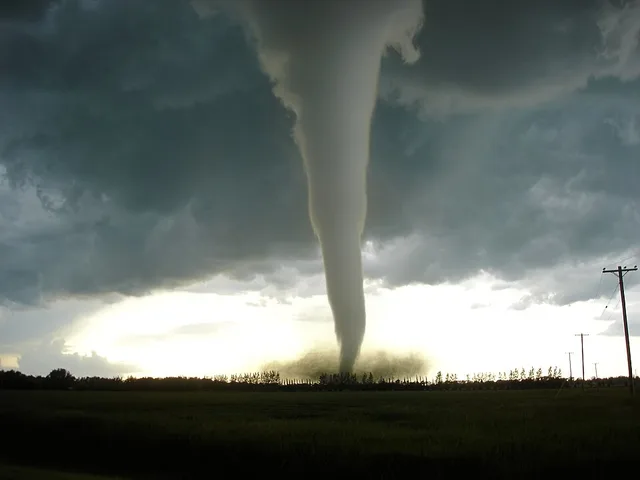
Tornadoes arise from supercell thunderstorms, the Earth's rotation (the Coriolis force) contributes to the rotation of large air masses, and the tornado fades when it touches the ground and loses its energy.
Initialization
Uniform random distribution inside the bounds of the search space.
Update mechanism
A hierarchy of solutions with the Coriolis force.
Exploration
The rotating motion of the windstorms and dissipation.
Exploitation
The storms turning into a tornado.
Mathematical description
The population is split into a tornado (the best solution), thunderstorms and windstorms. The windstorms move towards the thunderstorms and the tornado with a rotating motion to which the Coriolis force is added, and turn into tornadoes when they improve; then dissipation imitates regenerating some of the solutions.
This algorithm's equations were not included because they have not yet been matched with the original text. See the original reference below.
Computational complexity: O(T\cdot N\cdot (D + C_f))
Pseudocode
Initialize; tornado = best, thunderstorms, windstorms
for t = 1..T:
windstorms evolve toward thunderstorms/tornado (Coriolis rotation)
thunderstorms evolve toward tornado
tornado dissipation (regenerate some agents)
return tornadoPython implementation
There is currently no tested python implementation of this algorithm in the lab. We did not include untested code so that it is not used as a reference implementation.
Coefficients
No parameters recorded.
Advantages
Tested on 23 and 29 benchmark functions and constrained engineering problems.
Limitations
A hierarchical structure with several parameters.
Use in artificial intelligence
Domains documented in the card: Machine learning, deep learning, hyperparameter tuning
Continuous optimization and constrained engineering design.
Hybridization potential
These are partnerships suggested theoretically in the card; any resulting design is presented as a "proposed hybrid method" until its results are compared with the literature.
Applied research from the repository
An aspect that did not appear in the current search results within the repository. This does not mean there is no published research outside it.
Original reference
Malik Braik; Heba Al-Hiary; Hussein Alzoubi; Abdelaziz Hammouri; Mohammed Azmi Al-Betar; Mohammed A. Awadallah (2025). Tornado optimizer with Coriolis force: a novel bio-inspired meta-heuristic algorithm for solving engineering problems. Artificial Intelligence Review, Springer Science and Business Media LLC.
Verified DOI: 10.1007/s10462-025-11118-9
The title describes it as "bio-inspired" although its source is a weather phenomenon; it is classified here under physics. The description is based on the published abstract. The bibliographic data match the Crossref record (checked 2026-11-21). There is no tested Python code for this algorithm in this version.
