Water Cycle Algorithm
Water Cycle Algorithm (WCA)
- Year introduced
- 2012
- Original authors
- Hadi Eskandar; Ali Sadollah; Ardeshir Bahreininejad; Mohd Hamdi
- Source of inspiration
- The water cycle in nature
- Search space
- Continuous
- Optimization types
- Hyperparameter Optimization
- Applied research in the repository
- 0
Overview
The best solution is the sea, followed by the rivers, and the rest are streams. Streams flow towards rivers and rivers towards the sea, and when a river comes close enough to the sea, "evaporation" happens and new streams are generated randomly.
Source of inspiration and mechanism
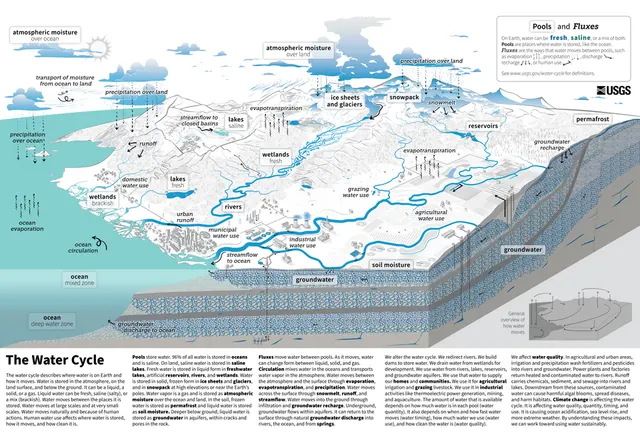
Streams flow into rivers and rivers into the sea, then the water evaporates and falls as rain to form new streams.
Initialization
Random raindrops.
Update mechanism
A three-level hierarchy.
Exploration
Rainfall after evaporation.
Exploitation
Attraction towards the sea.
Mathematical description
Table movement
X_{stream}^{t+1} = X_{stream}^{t} + r\cdot C\cdot (X_{river}^{t} - X_{stream}^{t}),\ C\approx 2Evaporation condition
\|X_{sea} - X_{river}\| < d_{max},\quad d_{max}^{t+1} = d_{max}^{t} - \frac{d_{max}^{t}}{T}Computational complexity: O(T\cdot N\cdot (D + C_f))
Pseudocode
Initialize raindrops; best = sea, next Nsr-1 = rivers, rest = streams
for t = 1..T:
move streams to rivers and to sea; move rivers to sea; swap if better
evaporation check; raining process creates new streams
decrease d_max
return seaPython implementation
There is currently no tested python implementation of this algorithm in the lab. We did not include untested code so that it is not used as a reference implementation.
Coefficients
| Parameter | Symbol | Typical value | Range | Description |
|---|---|---|---|---|
| Rivers+sea | N_sr | 4 | ||
| Constant | C | 2 | ||
| d_max | d_max | 1e-16 |
Advantages
Originally suited to constrained optimization.
Limitations
Uneven performance in high dimensions.
Use in artificial intelligence
Domains documented in the card: Machine learning, hyperparameter tuning
Constrained engineering optimization, continuous optimization.
Hybridization potential
These are partnerships suggested theoretically in the card; any resulting design is presented as a "proposed hybrid method" until its results are compared with the literature.
Applied research from the repository
An aspect that did not appear in the current search results within the repository. This does not mean there is no published research outside it.
Original reference
Hadi Eskandar; Ali Sadollah; Ardeshir Bahreininejad; Mohd Hamdi (2012). Water cycle algorithm – A novel metaheuristic optimization method for solving constrained engineering optimization problems. Computers & Structures, Elsevier BV.
Verified DOI: 10.1016/j.compstruc.2012.07.010
There is no tested Python code for this algorithm in this version.
