Water Uptake and Transport in Plants Algorithm
Water Uptake and Transport in Plants Algorithm (WUTP)
- Year introduced
- 2025
- Original authors
- Malik Braik; Heba Al-Hiary
- Source of inspiration
- Water uptake and transport in plants (the xylem)
- Search space
- Continuous
- Optimization types
- Hyperparameter Optimization
- Applied research in the repository
- 0
Overview
An algorithm inspired by how plants absorb water from the soil through their roots and transport it through the xylem to the leaves. The paper's abstract states that it produces better solutions than other algorithms in terms of global optimality, accuracy and reliability on numerical problems.
Source of inspiration and mechanism
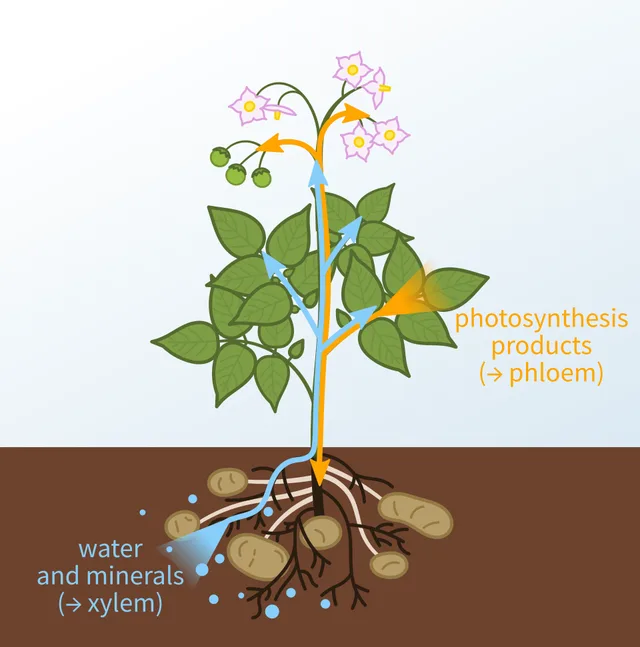
The roots absorb water by osmosis, then it is pulled up the xylem vessels to the leaves by transpiration, the evaporation of water from the stomata, together with the cohesion of water molecules and their adhesion to the vessel walls.
Initialization
Uniform random distribution inside the bounds of the search space.
Update mechanism
Mechanisms inspired by water transport in plants.
Exploration
The absorption stage from the soil.
Exploitation
Rising towards the leaves (the best solution).
Mathematical description
The algorithm models the stages of water uptake and transport (absorption in the roots, rising through the xylem, and transpiration from the leaves) as update mechanisms for exploration and exploitation. The mathematical details are in the original paper.
This algorithm's equations were not included because they have not yet been matched with the original text. See the original reference below.
Computational complexity: O(T\cdot N\cdot (D + C_f))
Pseudocode
Initialize
for t = 1..T:
water uptake (roots) / transport (xylem) / transpiration (leaves) updates
update best
return bestPython implementation
There is currently no tested python implementation of this algorithm in the lab. We did not include untested code so that it is not used as a reference implementation.
Coefficients
No parameters recorded.
Advantages
One of the few recent plant-based algorithms.
Limitations
The comparative results were published by the authors and have not been reproduced experimentally in this encyclopedia.
Use in artificial intelligence
Domains documented in the card: Machine learning, deep learning, hyperparameter tuning
Continuous numerical optimization.
Hybridization potential
These are partnerships suggested theoretically in the card; any resulting design is presented as a "proposed hybrid method" until its results are compared with the literature.
Applied research from the repository
An aspect that did not appear in the current search results within the repository. This does not mean there is no published research outside it.
Original reference
Malik Braik; Heba Al-Hiary (2025). A novel meta-heuristic optimization algorithm inspired by water uptake and transport in plants. Neural Computing and Applications, Springer Science and Business Media LLC.
Verified DOI: 10.1007/s00521-025-11228-z
The paper's abstract is not available in Crossref; the description is based on the brief Semantic Scholar summary and the paper's title, and the mathematical details are in the original paper. The bibliographic data match the Crossref record (checked 2026-11-21). There is no tested Python code for this algorithm in this version.
