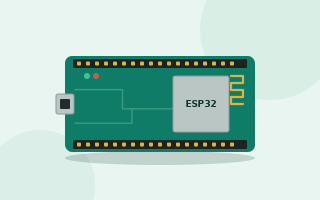
ESP32
A family of Espressif microcontrollers with built-in Wi-Fi and Bluetooth, widely used in educational and commercial IoT projects.
Guide to devices and components: microcontrollers, single-board computers and edge hardware. A specification is listed only when confirmed by official documentation.
Educational content in scientific-draft form; a specialist should review it before it is adopted as an academic reference. No measurement or performance result that was not actually obtained is shown here.
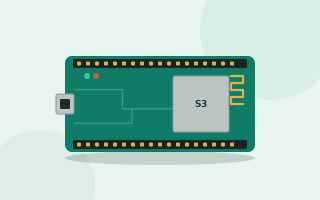
A family of Espressif microcontrollers with built-in Wi-Fi and Bluetooth, widely used in educational and commercial IoT projects.
A low-cost Wi-Fi microcontroller that preceded the ESP32 and is still common in simple projects.
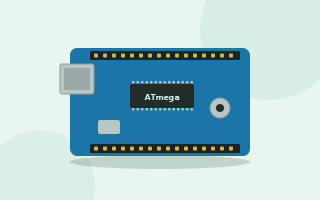
An educational board built on an 8-bit microcontroller, well known for learning electronics and embedded programming.
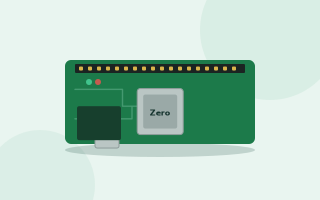
A single-board computer with a full operating system, used as a local gateway or as a development platform for heavier applications.
A Raspberry Pi microcontroller board built on the RP2040 chip, supporting MicroPython and C/C++.
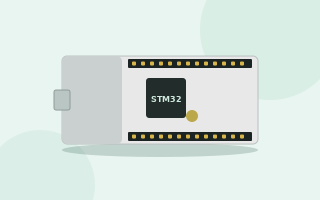
A family of microcontrollers from STMicroelectronics and Nucleo development boards, used in industrial and professional embedded systems.
A family of edge-AI computing modules from NVIDIA that integrate a graphics processing unit for inference.
A small board with built-in sensors and BLE connectivity, frequently used in educational TinyML examples.
Hardware products (boards and USB/PCIe accessories) that accelerate inference for compressed models at the edge.
A hardware/software concept: an intermediary device that collects the data of several nodes, translates between their protocols and sends it to the cloud or processes it…
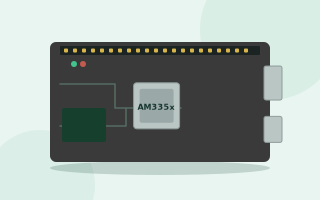
Espressif microcontroller with dual Xtensa cores, Wi-Fi, Bluetooth LE and vector instructions that help accelerate small neural networks.
Espressif Wi-Fi and Bluetooth LE microcontroller built around a single RISC-V core, a low-cost option for simple nodes.
A low-cost module combining an ESP32 with a small camera and a memory-card slot, widely used in simple vision examples.
A small Arduino-family board built around an 8-bit microcontroller, suited to space-constrained projects.
An Arduino board with many I/O pins, suited to projects that need numerous sensors and actuators.
A very small single-board computer running a full OS with Wi-Fi and Bluetooth, lighter than full-size Raspberry Pi boards.
The RP2040-based Pico board with added Wi-Fi and Bluetooth LE.
A PJRC board built on a fast ARM Cortex-M7 microcontroller, used where signal processing needs exceed typical hobby boards.
A Nordic Semiconductor development kit for the nRF52840, which supports Bluetooth LE and 802.15.4 protocols such as Thread and Zigbee.
An open-hardware single-board computer from BeagleBoard.org with PRU real-time units alongside Linux.
A very small Seeed Studio board that pairs an ESP32-S3 with an expansion carrying a camera and a microphone, suited to visual and audio TinyML.
A small machine-vision camera programmable in MicroPython, designed for edge-vision experiments.
A Luxonis depth and AI camera that integrates an inference accelerator so neural networks run on the camera itself.
An M.2 add-on for Raspberry Pi 5 that adds a Hailo inference accelerator, turning the board into an edge-vision platform.
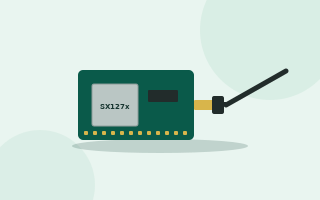
Radio modules based on Semtech SX127x chips for LoRa, wired to a microcontroller to create long-range low-power links.
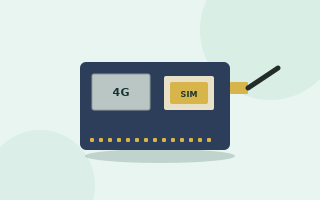
Modules that add cellular connectivity to a microcontroller; the supported generations differ between models and depend on the networks available in a country.
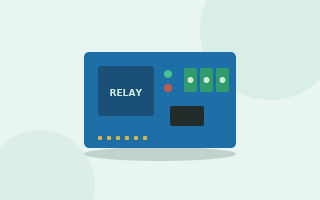
A module that lets a low-voltage microcontroller switch higher loads such as pumps and lamps through an electromechanical relay.
A small monochrome display, usually connected over I2C or SPI, used to show sensor readings locally.
Common power parts for portable IoT devices: a rechargeable lithium cell and a charging module built on the TP4056 chip.
A real-time clock module with a temperature-compensated oscillator that keeps time through power loss thanks to a small battery.
No matching results.
Simulations and labs run inside your browser. Nothing you enter and none of the conversations is stored on the server. Privacy policy
Sections
No section has this name. Press “Search” to search all site content.
Favourites
My results & certificates
My academy progressMy quiz resultsKids’ progressAcademy certificatesQuiz certificatesStart any lesson or quiz and it will show up here so you can get back to it quickly.
Settings
I am the AIoT specialist assistant. Ask me about a sensor, device, protocol, architecture or project, and I will answer from the section's content with links.
It answers from the section database only, without sending your question to any outside party. Conversations are not stored.
The assistant can make mistakes, so check the attached sources.
Welcome! I am Dr. Alaa Taima, and this is my smart assistant on “Deep Learning in Arabic”. Ask it about any term or topic in artificial intelligence, and it will answer from the site's content with links to the sources.
Enter to send · Shift + Enter for a new line · The assistant can make mistakes, so check the sources.