Osprey Optimization Algorithm
Osprey Optimization Algorithm (OOA)
- Year introduced
- 2023
- Original authors
- Mohammad Dehghani; Pavel Trojovský
- Source of inspiration
- Osprey
- Search space
- Continuous
- Optimization types
- Hyperparameter Optimization
- Applied research in the repository
- 0
Overview
It imitates how the osprey (the fish hawk) hunts fish: it locates a fish and attacks it (exploration), then carries it to a safe place to eat it (exploitation with steps that shrink over time).
Source of inspiration and mechanism
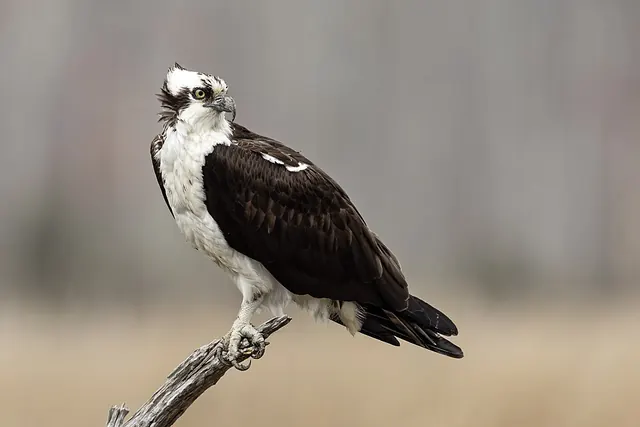
The osprey is a bird of prey that feeds on fish; it soars over the water, then plunges feet first to catch a fish and carries it to a safe high perch.
Initialization
Random.
Update mechanism
Two phases with greedy acceptance.
Exploration
Picking a random fish from the better solutions.
Exploitation
The decreasing step (lb + r(ub−lb))/t.
Mathematical description
The candidate fish are the solutions better than the current one; the osprey picks one at random, SF, and moves x + r(SF − I·x). In the second phase x + (lb + r(ub − lb))/t. Both use greedy acceptance.
Locating and attacking the prey
x_{i,j}^{P1} = x_{i,j} + r_{i,j}\,(SF_{i,j} - I_{i,j}\,x_{i,j})Carrying the prey
x_{i,j}^{P2} = x_{i,j} + \frac{lb_j + r\,(ub_j - lb_j)}{t}Computational complexity: O(T\cdot N\cdot (D + C_f))
Flowchart
A simplified chart summarising the algorithm phases as described on its card in the lab; it is not the original figure published in the paper.
Pseudocode
Initialize
for t = 1..T:
for each osprey: FP = {better solutions}; SF = random from FP
phase 1: x + r*(SF - I*x); accept if better
phase 2: x + (lb + r*(ub - lb))/t; accept if better
return bestPython implementation
There is currently no tested python implementation of this algorithm in the lab. We did not include untested code so that it is not used as a reference implementation.
Coefficients
| Parameter | Symbol | Typical value | Range | Description |
|---|---|---|---|---|
| Population | N | 30 |
Advantages
No tuning parameters.
Limitations
The second step decreases at a rate of 1/t whatever the run length.
Use in artificial intelligence
Domains documented in the card: Machine learning, hyperparameter tuning
Continuous engineering problems.
Hybridization potential
These are partnerships suggested theoretically in the card; any resulting design is presented as a "proposed hybrid method" until its results are compared with the literature.
Applied research from the repository
An aspect that did not appear in the current search results within the repository. This does not mean there is no published research outside it.
Original reference
Mohammad Dehghani; Pavel Trojovský (2023). Osprey optimization algorithm: A new bio-inspired metaheuristic algorithm for solving engineering optimization problems. Frontiers in Mechanical Engineering, Frontiers Media SA.
Verified DOI: 10.3389/fmech.2022.1126450
External links collected from a search index and from paper abstracts; check that they are the original authors’ code and that they work before relying on them.
The bibliographic data match the Crossref record (checked 2026-11-20). There is no tested Python code for this algorithm in this version.