Interactive labs for speech recognition, speech synthesis, and audio in general: in-browser DSP experiments, algorithms, datasets, and a learning path, without storing any recording.
Educational content in the form of a scientific draft that needs expert review before being adopted as an academic reference. No experimental result that was not actually run is shown here.
Definition
A classifier that searches for a separating hyperplane with the largest margin between two classes. It can be extended to nonlinear cases with kernels and to multiple classes with binary combinations.
Mathematical Idea
It defines the hyperplane $w^\top x+b=0$ and the margin $2/\|w\|$. We minimize $\tfrac12\|w\|^2+C\sum_i\max(0,1-y_i(w^\top x_i+b))$, where $C$ balances margin against errors. The support vectors are the points on or inside the margin, and they alone determine the hyperplane. With the kernel $K(x,x')$ we obtain nonlinear boundaries without computing the projection explicitly.
McFee, Raffel, Liang, Ellis, McVicar, Battenberg, et al.. librosa: Audio and Music Signal Analysis in Python. Proceedings of the 14th Python in Science Conference (2015).DOI
Audio processing in the experiments takes place inside your browser. Audio, texts, and conversations are not saved on the server. Privacy Policy
Assistant Professor of Artificial Intelligence and Deep Learning
University of Al-Qadisiyah
About
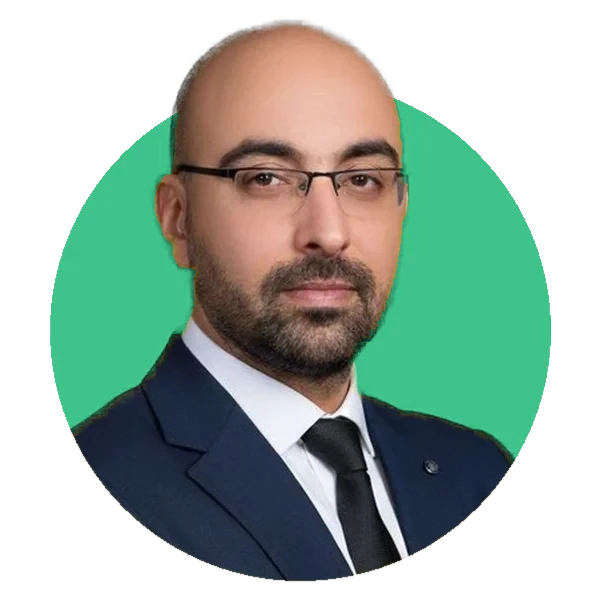
Researcher and academic specialising in artificial intelligence (AI), deep learning, computer vision and natural language processing (NLP). The “Deep Learning in Arabic” project aims to enrich Arabic scientific and technical content with sound, free references and software for researchers and learners across the Arab world.
Smart Audio Assistant
I am the lab's Audio Assistant. Ask me about an algorithm, model, dataset, or experiment, and I will answer from the lab's content with links.
Smart Audio Assistant
Local mode: the lab's database
It answers from the lab's database only, without sending your question to any external party. Conversations and audio are not saved.
Smart assistant
Answers from the site’s content
The assistant can make mistakes, so check the attached sources.
Welcome! I am Dr. Alaa Taima, and this is my smart assistant on “Deep Learning in Arabic”. Ask it about any term or topic in artificial intelligence, and it will answer from the site's content with links to the sources.
DL Bot
Your smart assistant · Connecting…
Enter to send · Shift + Enter for a new line · The assistant can make mistakes, so check the sources.