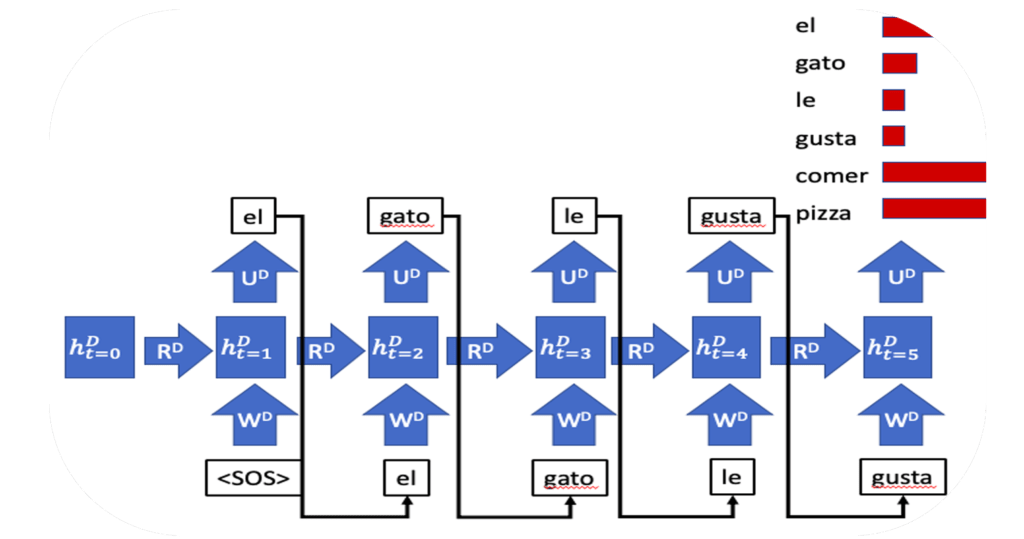
Machine Translation is one of the most challenging tasks in artificial intelligence; it works by examining the use of software to translate text or speech from one language to another. In this article, I will take you through machine translation with neural networks.
By the end of this article, you will learn to develop a machine translation model with neural networks and Python. I will use English as the input, and we will train our machine translation model to give its output in French. Let's now start by importing all the libraries we need for this task:
import collections
import helper
import numpy as np
import project_tests as tests
from keras.preprocessing.text import Tokenizer
from keras.preprocessing.sequence import pad_sequences
from keras.models import Model
from keras.layers import GRU, Input, Dense, TimeDistributed, Activation, RepeatVector, Bidirectional
from keras.layers.embeddings import Embedding
from keras.optimizers import Adam
from keras.losses import sparse_categorical_crossentropy
I will first create two functions to load the data and another function to test our data:
import os
def load_data(path):
    """
    Load dataset
    """
    input_file = os.path.join(path)
    with open(input_file, "r") as f:
        data = f.read()

    return data.split('\n')
def _test_model(model, input_shape, output_sequence_length, french_vocab_size):
    if isinstance(model, Sequential):
        model = model.model

    assert model.input_shape == (None, *input_shape[1:]),\
        'Wrong input shape. Found input shape {} using parameter input_shape={}'.format(model.input_shape, input_shape)

    assert model.output_shape == (None, output_sequence_length, french_vocab_size),\
        'Wrong output shape. Found output shape {} using parameters output_sequence_length={} and french_vocab_size={}'\
            .format(model.output_shape, output_sequence_length, french_vocab_size)

    assert len(model.loss_functions) > 0,\
        'No loss function set.  Apply the `compile` function to the model.'

    assert sparse_categorical_crossentropy in model.loss_functions,\
        'Not using `sparse_categorical_crossentropy` function for loss.
Let's now load the data and take a look at some insights from it, since the dataset I am using here contains English phrases with their translations:
english_sentences = helper.load_data('data/small_vocab_en')
french_sentences = helper.load_data('data/small_vocab_fr')
print('Dataset Loaded')
Dataset loaded
for sample_i in range(2):
    print('small_vocab_en Line {}:  {}'.format(sample_i + 1, english_sentences[sample_i]))
    print('small_vocab_fr Line {}:  {}'.format(sample_i + 1, french_sentences[sample_i]))
small_vocab_en Line 1: new jersey is sometimes quiet during autumn , and it is snowy in april . small_vocab_fr Line 1: new jersey est parfois calme pendant l' automne , et il est neigeux en avril . small_vocab_en Line 2: the united states is usually chilly during july , and it is usually freezing in november . small_vocab_fr Line 2: les états-unis est généralement froid en juillet , et il gèle habituellement en novembre .
As we translate language, the complexity of this problem will be determined by the complexity of the vocabulary. The more complex the vocabulary of our language, the more complex our problem. Let's look at the data to see how complex the data we are dealing with is:
english_words_counter = collections.Counter([word for sentence in english_sentences for word in sentence.split()])
french_words_counter = collections.Counter([word for sentence in french_sentences for word in sentence.split()])
print('{} English words.'.format(len([word for sentence in english_sentences for word in sentence.split()])))
print('{} unique English words.'.format(len(english_words_counter)))
print('10 Most common words in the English dataset:')
print('"' + '" "'.join(list(zip(*english_words_counter.most_common(10)))[0]) + '"')
print()
print('{} French words.'.format(len([word for sentence in french_sentences for word in sentence.split()])))
print('{} unique French words.'.format(len(french_words_counter)))
print('10 Most common words in the French dataset:')
print('"' + '" "'.join(list(zip(*french_words_counter.most_common(10)))[0]) + '"')
1823250 English words.
227 unique English words.
10 Most common words in the English dataset:
"is" "," "." "in" "it" "during" "the" "but" "and" "sometimes"

1961295 French words.
355 unique French words.
10 Most common words in the French dataset:
"est" "." "," "en" "il" "les" "mais" "et" "la" "parfois"
Data preprocessing
In machine learning, whenever we deal with any kind of text values, we first need to convert them into sequences of integers using two basic methods: Tokenize and Padding. Let's now start with Tokenization:
def tokenize(x):
    x_tk = Tokenizer(char_level = False)
    x_tk.fit_on_texts(x)
    return x_tk.texts_to_sequences(x), x_tk
text_sentences = [
    'The quick brown fox jumps over the lazy dog .',
    'By Jove , my quick study of lexicography won a prize .',
    'This is a short sentence .']
text_tokenized, text_tokenizer = tokenize(text_sentences)
print(text_tokenizer.word_index)
print()
for sample_i, (sent, token_sent) in enumerate(zip(text_sentences, text_tokenized)):
    print('Sequence {} in x'.format(sample_i + 1))
    print('  Input:  {}'.format(sent))
    print('  Output: {}'.format(token_sent))
{'the': 1, 'quick': 2, 'a': 3, 'brown': 4, 'fox': 5, 'jumps': 6, 'over': 7, 'lazy': 8, 'dog': 9, 'by': 10, 'jove': 11, 'my': 12, 'study': 13, 'of': 14, 'lexicography': 15, 'won': 16, 'prize': 17, 'this': 18, 'is': 19, 'short': 20, 'sentence': 21}

Sequence 1 in x
  Input:  The quick brown fox jumps over the lazy dog .
  Output: [1, 2, 4, 5, 6, 7, 1, 8, 9]
Sequence 2 in x
  Input:  By Jove , my quick study of lexicography won a prize .
  Output: [10, 11, 12, 2, 13, 14, 15, 16, 3, 17]
Sequence 3 in x
  Input:  This is a short sentence .
  Output: [18, 19, 3, 20, 21]
Let's now use the padding method to make all the sequences the same length:
def pad(x, length=None):
    if length is None:
        length = max([len(sentence) for sentence in x])
    return pad_sequences(x, maxlen = length, padding = 'post')
tests.test_pad(pad)
# Pad Tokenized output
test_pad = pad(text_tokenized)
for sample_i, (token_sent, pad_sent) in enumerate(zip(text_tokenized, test_pad)):
    print('Sequence {} in x'.format(sample_i + 1))
    print('  Input:  {}'.format(np.array(token_sent)))
    print('  Output: {}'.format(pad_sent))
Sequence 1 in x
  Input:  [1 2 4 5 6 7 1 8 9]
  Output: [1 2 4 5 6 7 1 8 9 0]
Sequence 2 in x
  Input:  [10 11 12  2 13 14 15 16  3 17]
  Output: [10 11 12  2 13 14 15 16  3 17]
Sequence 3 in x
  Input:  [18 19  3 20 21]
  Output: [18 19  3 20 21  0  0  0  0  0]
A preprocessing pipeline for machine translation
Let's now define a preprocessing function to create a pipeline for the machine translation task, so that we can use this model in the future too:
def preprocess(x, y):
    preprocess_x, x_tk = tokenize(x)
    preprocess_y, y_tk = tokenize(y)
preprocess_x = pad(preprocess_x)
    preprocess_y = pad(preprocess_y)
# Keras's sparse_categorical_crossentropy function requires the labels to be in 3 dimensions
    preprocess_y = preprocess_y.reshape(*preprocess_y.shape, 1)
return preprocess_x, preprocess_y, x_tk, y_tk
preproc_english_sentences, preproc_french_sentences, english_tokenizer, french_tokenizer =\
    preprocess(english_sentences, french_sentences)

max_english_sequence_length = preproc_english_sentences.shape[1]
max_french_sequence_length = preproc_french_sentences.shape[1]
english_vocab_size = len(english_tokenizer.word_index)
french_vocab_size = len(french_tokenizer.word_index)
print('Data Preprocessed')
print("Max English sentence length:", max_english_sequence_length)
print("Max French sentence length:", max_french_sequence_length)
print("English vocabulary size:", english_vocab_size)
print("French vocabulary size:", french_vocab_size)
Data Preprocessed
Max English sentence length: 15
Max French sentence length: 21
English vocabulary size: 199
French vocabulary size: 344
Training a neural network for machine translation
Now I will train a model with neural networks here. Let's start by creating a helper function:
def logits_to_text(logits, tokenizer):
    index_to_words = {id: word for word, id in tokenizer.word_index.items()}
    index_to_words[0] = '<PAD>'
return ' '.join([index_to_words[prediction] for prediction in np.argmax(logits, 1)])
print('`logits_to_text` function loaded.')
Now I will train an RNN model, which will serve as a very good baseline for our sequences and can translate English into French:
def simple_model(input_shape, output_sequence_length, english_vocab_size, french_vocab_size):
    learning_rate = 1e-3
    input_seq = Input(input_shape[1:])
    rnn = GRU(64, return_sequences = True)(input_seq)
    logits = TimeDistributed(Dense(french_vocab_size))(rnn)
    model = Model(input_seq, Activation('softmax')(logits))
    model.compile(loss = sparse_categorical_crossentropy,
                 optimizer = Adam(learning_rate),
                 metrics = ['accuracy'])

    return model
tests.test_simple_model(simple_model)
tmp_x = pad(preproc_english_sentences, max_french_sequence_length)
tmp_x = tmp_x.reshape((-1, preproc_french_sentences.shape[-2], 1))
# Train the neural network
simple_rnn_model = simple_model(
    tmp_x.shape,
    max_french_sequence_length,
    english_vocab_size,
    french_vocab_size)
simple_rnn_model.fit(tmp_x, preproc_french_sentences, batch_size=1024, epochs=10, validation_split=0.2)
# Print prediction(s)
print(logits_to_text(simple_rnn_model.predict(tmp_x[:1])[0], french_tokenizer))
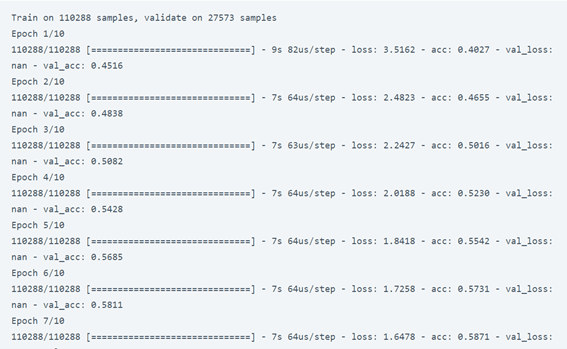
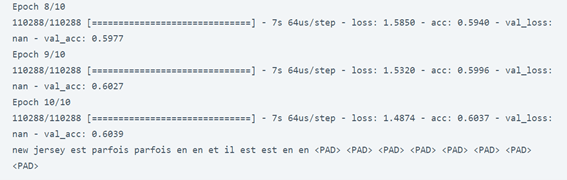
The RNN model gave us only 60 percent accuracy, so let's use a more complex neural network to train our model with better accuracy. I will now train our model with an RNN with embedding. An embedding represents a word as a vector that lies very close to similar words in an n-dimensional space. Here n is the size of the embedding vectors:
from keras.models import Sequential
def embed_model(input_shape, output_sequence_length, english_vocab_size, french_vocab_size):
    learning_rate = 1e-3
    rnn = GRU(64, return_sequences=True, activation="tanh")

    embedding = Embedding(french_vocab_size, 64, input_length=input_shape[1])
    logits = TimeDistributed(Dense(french_vocab_size, activation="softmax"))

    model = Sequential()
    #em can only be used in first layer --> Keras Documentation
    model.add(embedding)
    model.add(rnn)
    model.add(logits)
    model.compile(loss=sparse_categorical_crossentropy,
                  optimizer=Adam(learning_rate),
                  metrics=['accuracy'])

    return model
tests.test_embed_model(embed_model)
tmp_x = pad(preproc_english_sentences, max_french_sequence_length)
tmp_x = tmp_x.reshape((-1, preproc_french_sentences.shape[-2]))
embeded_model = embed_model(
    tmp_x.shape,
    max_french_sequence_length,
    english_vocab_size,
    french_vocab_size)
embeded_model.fit(tmp_x, preproc_french_sentences, batch_size=1024, epochs=10, validation_split=0.2)
print(logits_to_text(embeded_model.predict(tmp_x[:1])[0], french_tokenizer))
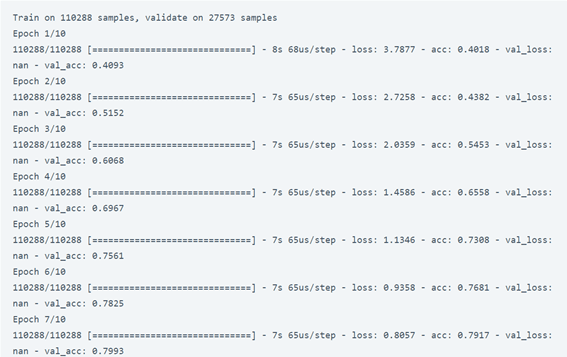
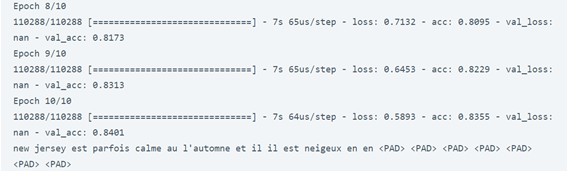
So our RNN model with embedding achieved a very good accuracy of 84 percent. I hope you liked this article on machine translation with neural networks and Python.
Post links
- Source: Machine Translation Model
Browse the book
Cite this book
Taima, Alaa. (2022). Project 14: A Machine Translation Model with Deep Learning. Deep Learning in Arabic. https://dlarabic.com/en/articles/project-14-a-machine-translation-model-with-deep-learning/
@book{taimaa2022_1040,
  title     = {Project 14: A Machine Translation Model with Deep Learning},
  author    = {Taima, Alaa},
  year      = {2022},
  publisher = {Deep Learning in Arabic},
  url       = {https://dlarabic.com/en/articles/project-14-a-machine-translation-model-with-deep-learning/},
  language  = {arabic}
}





Hi, this is a comment.
To get started with moderating, editing, and deleting comments, please visit the Comments screen in the dashboard.